
Community Engagement
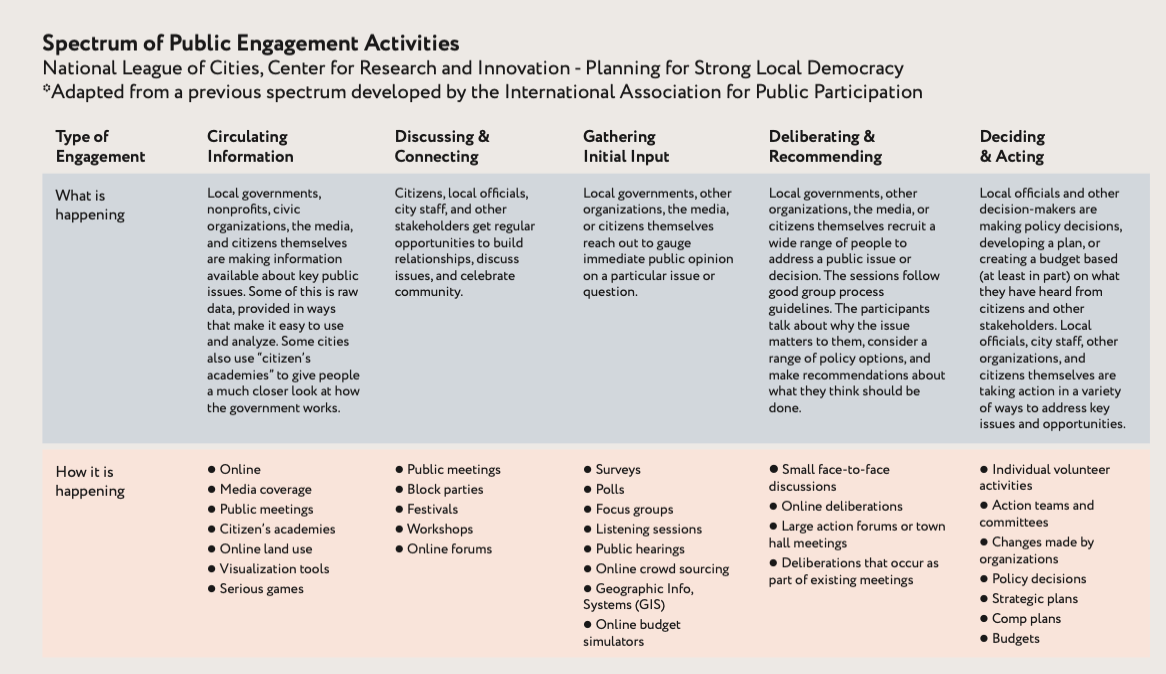
›› Understand Community Engagement strategies. Learn about various techniques for involving residents in decision-making, from participatory planning to co-creation of policies. The Planning for Stronger Local Democracy guide from the National League of Cities outlines various types of public engagement, including informing, consulting, involving, collaborating, and empowering, each with different levels of public input and impact.
– View the guide (see Page 12 for engagement types)
›› Participate in mini-grant programs. Mini-grants support small, resident-led community improvement projects. These grants fund grassroots efforts and invite residents to take leadership roles in shaping their neighborhoods. For example, Lincoln’s Community Builder Coalition pairs mini-grants with organizing support to build long-term local capacity.
– Learn about mini-grants
– Apply in Lincoln through Strong Neighborhoods
›› Encourage better meeting participation. If you’re a local leader or community organizer, there are specific strategies you can use to make public meetings more inclusive, accessible, and welcoming to new voices.
– How to increase attendance at a public meeting
›› Serve on local boards and commissions. Getting appointed to a local board or commission lets you contribute directly to decisions that affect your community’s development, infrastructure, parks, schools, and more. These roles often need new voices and perspectives from younger and more diverse residents. Check with your city or county government for open positions.
›› Assess your community’s civic health. Use Civic Nebraska’s Civic Health Index Assessment & Discussion Guide to evaluate your community’s strengths and areas for improvement. The tool encourages discussion and action planning based on data and lived experience.
– Download the guide
›› Facilitate or join community conversations
The All-America Conversations Toolkit offers practical methods to bring residents together across differences, uncover shared hopes and concerns, and build trust. It includes sample agendas, discussion guides, and outreach tips.
– Get the toolkit
›› Use accessible civic language
The Civic Language Perceptions Project, conducted by PACE, examines how various audiences interpret standard civic terms. This helps leaders and organizers avoid alienating language and ensures engagement efforts resonate more broadly.
– Explore the Civic Language Perceptions Project
›› Learn from promising civic engagement models. The Promising Practices Database from the National Civic League showcases successful civic engagement projects from communities nationwide. Use these examples to inspire similar efforts in your town or region.
– Browse the database
›› Get organized before you engage. Before launching a community engagement effort, especially as a city or nonprofit leader, use the Before You Begin checklist to ensure clarity of purpose, inclusivity, and readiness for authentic participation.
– Use the Before You Begin checklist
›› Try specific citizen engagement techniques. Explore a curated list of practical strategies to deepen resident involvement, such as service design workshops, citizen advisory boards, and co-creation processes.
– See citizen engagement techniques
Civic Media and Journalism
›› Join or support the Nebraska Documenters. Documenters, a collaboration between Civic Nebraska and Nebraska Journalism Trust, equips everyday Nebraskans to attend and take notes at local public meetings. These citizen journalists help fill the news gaps in rural areas and increase government transparency by publishing accessible meeting summaries. Participants are trained, paid, and supported.
– Learn more
›› Read and engage with the Flatwater Free Press
Flatwater Free Press is Nebraska’s first independent, nonprofit newsroom focused on investigative and explanatory journalism. Its stories highlight statewide issues that traditional outlets often overlook. Subscribing, sharing stories, or submitting tips helps elevate important conversations and hold public institutions accountable.
– Visit Flatwater Free Press
›› Connect with Nebraska Public Media.
For decades, Nebraska Public Media has served the state through public radio, television, and digital platforms. It delivers national and local reporting, public affairs programming, and original stories that help Nebraskans stay informed and engaged. You can tune in, attend events, and contribute your story ideas.
– Explore Nebraska Public Media
›› Explore the Healthy Democracy Ecosystem Map. This interactive map, created by Citizen Connect and supported by the Hewlett Foundation, charts hundreds of U.S. organizations working to strengthen democracy. You can search by state, issue area, or activity to find groups near you that are working on civic education, media literacy, voter engagement, and more.
– Explore the map
Civic Education and Youth Leadership
›› Learn how the Nebraska Legislature works. Nebraska has the only one-house, nonpartisan state legislature in the nation, which gives residents a unique and direct opportunity to impact the lawmaking process. Understanding how it works is the first step to civic engagement.
– Nebraska Legislature
›› Attend a Capitol Experience Day through Civic Nebraska. These immersive, daylong visits to the Nebraska State Capitol offer participants hands-on learning about state government, including Q&A sessions with lawmakers, guided tours, and mock committee hearings. Capitol Experience Days are tailored for students and adults to build confidence and civic skills.
– Capitol Experience Days
›› Explore law-related civic education resources from the Nebraska State Bar Association. Teachers and community leaders can integrate these free, classroom-ready materials into their lesson plans to support civic learning, critical thinking, and student engagement with democracy. Resources include simulations, games, and curriculum for all grade levels.
– Nebraska State Bar Association Civics Education
›› Schedule a Nebraska History Museum field trip. Students and youth groups can explore Nebraska’s civic and cultural history using award-winning, interactive learning experiences designed around genuine artifacts and primary sources. The museum offers programming tailored to each grade level.
– Nebraska History Museum Education
›› Introduce children to Nebraska’s government through Unicam Kids. This resource offers engaging videos, games, and kid-friendly content to explain the state’s legislative process, helping younger Nebraskans understand their role in civic life. It’s an excellent tool for parents, teachers, and youth leaders.
– Unicam Kids
›› Encourage high schoolers to participate in the Unicameral Youth Legislature. This four-day summer program simulates the legislative process, allowing students to serve as senators, sponsor bills, conduct hearings, and debate issues in the actual legislative chamber. It’s ideal for youth interested in leadership, politics, or public service.
– Unicameral Youth Legislature
›› Join the Connecting Young Nebraskans network. Nebraskans aged 21 to 40 can connect with peers statewide to develop leadership skills, expand their professional networks, and participate in events that strengthen their communities. CYN fosters inclusive, dynamic relationships among young leaders.
– Connecting Young Nebraskans
›› Enroll students in the New Americans Youth Leadership Academy (NAYLA). Designed for high school students in Lincoln who identify as New Americans, this weekly mentorship program builds civic knowledge, leadership skills, and community awareness through hands-on learning and service projects.
– NAYLA
›› Apply for the Nebraska Civic Leadership Program in Omaha. This experiential opportunity engages high school students in real-world government and civic systems, encouraging them to listen, learn, and lead in their communities. The program connects youth with civic mentors and decision-makers.
– Nebraska Civic Leadership Program
›› Host a voting simulation to teach youth about elections. This hands-on activity helps young people understand voting by walking them through ballots, polling stations, and the decision-making process. It builds familiarity and confidence before their first actual election.
›› Share your first voting story to inspire future voters. Adults can encourage civic participation by reflecting on their first experience at the polls and sharing those stories with students or young adults. It’s a powerful way to model lifelong civic engagement.
›› Incorporate nationally recognized civic education tools into classrooms. Free platforms like iCivics and Generation Citizen offer interactive, standards-aligned lessons and simulations that complement Nebraska-based initiatives. These tools help young people become informed and engaged community members.
Nonpartisan Voter Engagement and Support
›› Use TROVE to understand voter behavior in your community. The Tool to Reflect Overall Voter Engagement, or TROVE, is an interactive map-based resource that allows you to explore voter turnout in Nebraska by census tract, ZIP code, or county using official election data. You can search your address to view turnout patterns and apply the insights to shape civic outreach in your neighborhood.
– CivicNebraska.org/trove
›› Build your own nonpartisan voter engagement plan. Contact your county election office or visit the Nebraska Secretary of State’s website to confirm deadlines, request voter rolls, and determine your community’s registration status. Identify specific voter groups to target, such as new residents or recently eligible young adults, and establish measurable goals. Connect with other organizations to form partnerships that expand your capacity.
›› Offer nonpartisan voter registration training in your community. Invite a representative from your county clerk’s office to lead a training session and help community members understand how to register voters, whether online or by paper, correctly. Proper training improves confidence and ensures all forms are submitted correctly and on time.
›› Register voters where they are. Make registration opportunities highly visible by setting up tables at block parties, neighborhood association meetings, or local festivals. Meeting voters in familiar spaces increases their chances of engaging in the process.
›› Launch a door-to-door nonpartisan voter registration campaign. Residents can serve as neighborhood captains who are trained to register voters, keep accurate records, and follow up to ensure their neighbors turn out to vote. Captains are trusted messengers who play a decisive role in local engagement.
Link
›› Incorporate voter registration into your organization’s existing events. Whether you’re hosting a school open house, cultural celebration, or food distribution, including a voter registration table ensures attendees are offered a chance to participate in democracy.
– National Voter Registration Day
›› Use positive, personal messages to encourage voter registration. Many people disengage because they believe their vote doesn’t matter. Sharing real stories of close elections and connecting civic participation to personal values like education, safety, or housing can inspire action. Learn more about effective messaging from these field-tested approaches.
›› Educate voters about key election information. Help your neighbors understand who is on the ballot, what issues are being decided, where and when to vote, and how to do it, whether in person or by mail. This kind of voter education is a vital piece of election readiness.
›› Help get out the vote by providing transportation and supporting early voting. Volunteer to drive voters to the polls or partner with an organization like Rideshare2Vote Aware to ensure residents with limited mobility can still cast their ballots. Encourage early voting or vote-by-mail where applicable.
Link
›› Encourage voters to make a plan for casting their ballot. Research shows that individuals who plan when, where, and how they’ll vote are far more likely to follow through. Use this technique especially with new voters in your neighborhood, and follow up to answer questions or help solve logistical problems.
Link
›› Promote voter protection by ensuring everyone knows their rights. Distribute the nonpartisan Election Protection Hotline number (866-OUR-VOTE) and help voters understand what to do if they’re turned away from the polls or face voter intimidation. This proactive step builds voter confidence and reduces confusion on Election Day.
– Election Protection
›› Volunteer as a nonpartisan election observer. Trained observers watch the voting process in polling places across Nebraska to document problems, note accessibility concerns, and ensure fairness. Their observations are compiled into public reports that inform election officials and lawmakers.
›› Explore and share tools that make voter education and outreach easier. Resources like the Voter Education Design Toolkit and Civic Nebraska’s voter registration tools can help you create compelling, accurate materials to engage your community before each election.