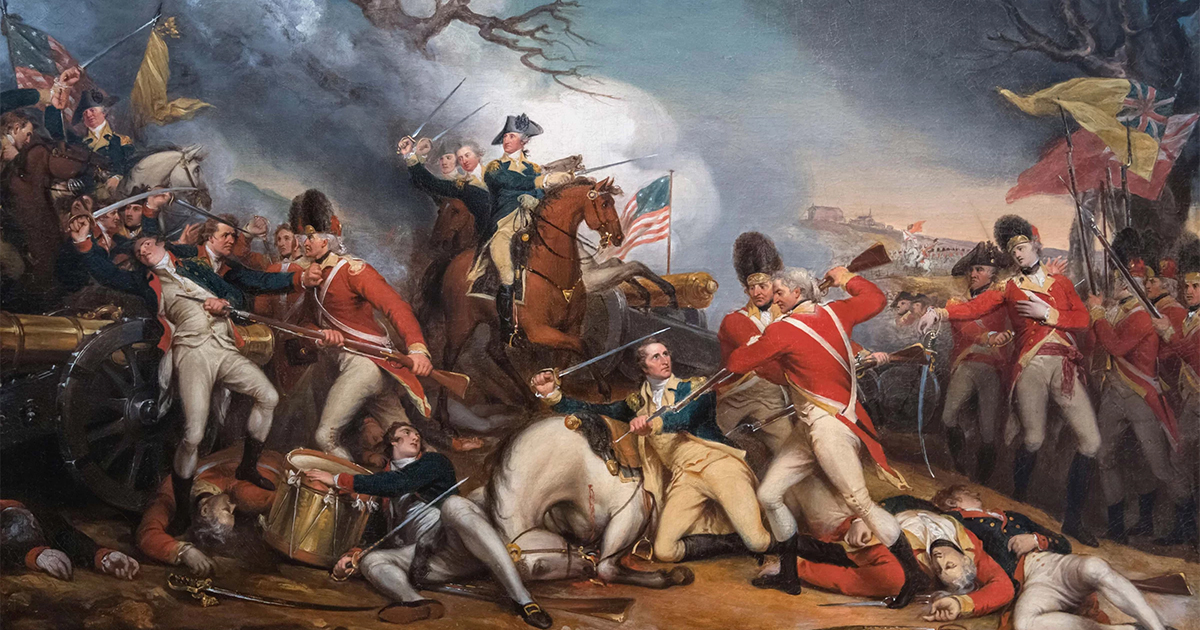
As we speed toward the 250th anniversary of American independence, one of our most trusted chroniclers of the nation’s story, Ken Burns, returns to the screen with a sweeping six-part, twelve-hour documentary, The American Revolution. Directed by Burns, Sarah Botstein, and David Schmidt, the series premieres Sunday [Nov. 16] on PBS.
What sets this project apart isn’t just its scope, but its ambition. Burns has said that his goal was to move beyond the familiar tableau of powdered wigs and parchment into the messy, human terrain of a revolution that was, as he puts it, “a war for independence, a war of conquest, a civil war, and a world war.” That suggests something much deeper than nostalgia or surface-level patriotism – it promises to be an examination of the complexity of how we came to be. If the advance reviews are any indication, it will be a masterful addition to the Revolutionary canon.
We’re grateful for a fresh look at this pivotal era. The founding period (1776-1789) occupies an almost mythic place in the minds of many Americans, but unlike most nations whose cohesion rests on shared ethnicity, language, or lineage, the United States was forged from a set of ideals. Centuries later, this understanding persists: A recent Nationhood Lab survey found that a vast majority of Americans continue to say we are united “not by a shared religion or ancestry or history, but by our shared commitment to a set of founding ideals.”
That belief – often fragile, aspirational, and tested – helps explain why we hold the stories and symbols of 1776 so tightly. Partly, we revere the Revolution because it stands in for a common origin, something other countries take for granted. The mythos of the founders, the iconography of the era, and the civic scripture of documents like the Declaration and the Constitution form the glue that holds together a people without a common bloodline.
Yet, as Burns and Co. emphasize, the myth is varnish. Beneath it lies contradiction, struggle, and the raw material of American democracy itself. The Atlantic noted in an early review, that The American Revolution aims to strip away romantic simplifications and return us to the texture of the age – “a story of conflict as much as unity, of division as much as destiny,” in their words.
We know this much: The timing couldn’t be better. We’re in an era in which the language and imagery of 1776 have become political shorthand, and so a thoughtful exploration of that period feels timely and necessary. Since the rise of the Tea Party movement in 2009, the iconography of colonial America has been adopted (and sometimes distorted) by modern political movements. Gadsden flags fly at rallies, Pine Tree banners make their “Appeal to Heaven” at protests, and citizens invoke “We The People” at public meetings. The colonial-era aesthetic – tri-cornered hats, cursive slogans, and Old English fonts – has become a kind of uniform for defiance, usually from the right.
The American Revolution challenges us to look beyond. What if the phrase “No Kings,” so resonant among progressives today, originally served not as a cry for egalitarian democracy but as an elite class’s demand to preserve its autonomy from a distant crown? The Revolution can be seen as both radically progressive and staunchly conservative – an upheaval in which landowners and merchants sought independence not just from tyranny, but from interference in their own affairs. That tension between liberty and privilege, between idealism and self-interest, still runs deep in America.