

Dear friends,
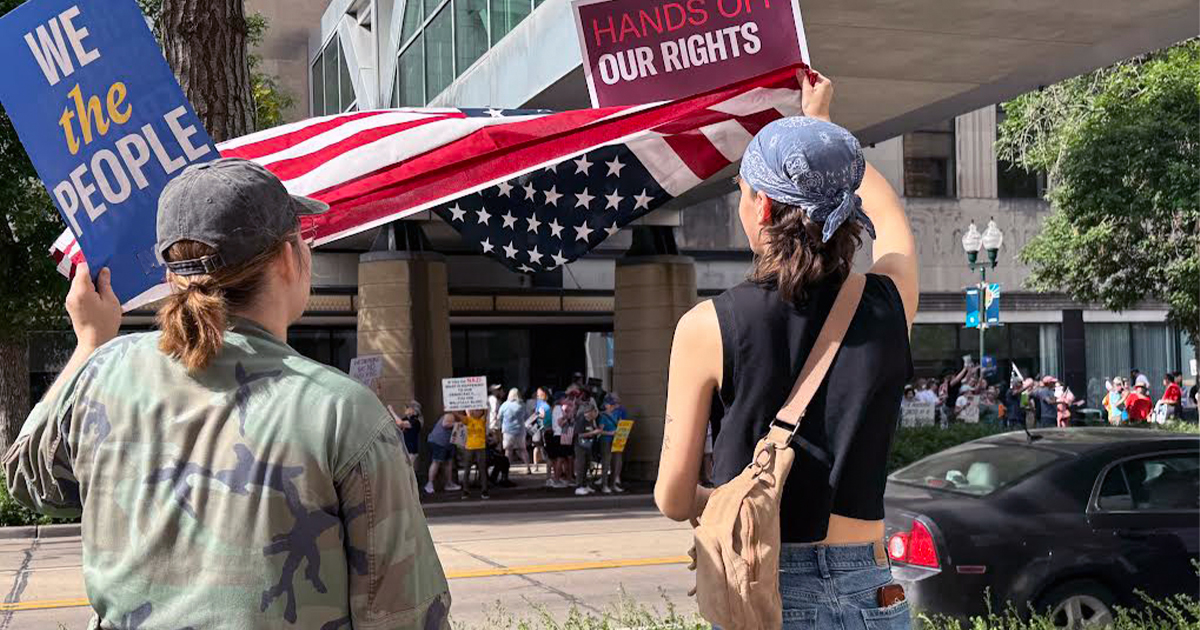
This weekend, you stood shoulder to shoulder in parks, on courthouse steps, in city streets, and on village greens across America. You raised your voices in unison for democracy, for the rule of law, and for the fundamental truth that in this nation, power flows from the people – not from a throne, not from a single man, and not from a movement that seeks to elevate one person above the Constitution.
You reminded the country and the world: We have no kings here.
Thank you.
Your presence matters. It matters to those who are frightened by the rising tide of authoritarianism and need to see that they are not alone. It matters to those in power who may believe the people are asleep. It matters to history, which will record that Americans did not sit quietly as democracy was challenged.
But marching is not the movement. It’s the signal of a movement. Without action to follow, it becomes performance, not progress. And while the spectacle may be stirring, spectacle alone does not safeguard democracy.
So, what comes next? We have six broad suggestions to consider as you move forward. Click on the headlines below to learn more.

Marching shows you care. Now, show you’re committed. Movements are made in motion, not just in moments.
Start with the basics: Register to vote, and make sure your registration is active and accurate — especially if you’ve moved, changed your name, or haven’t voted in a while. Check in with your friends, family, co-workers, and neighbors. Ask them to do the same. Make it a group effort. Authoritarianism thrives when everyday people check out of the democratic process. Participation is our first line of defense.
But voting is just the beginning. Volunteer with organizations that are building civic power year-round, not just at election time. Whether it’s phone-banking, text-banking, knocking on doors, or supporting local campaigns for fair elections and democratic reform, your time and skills can help shape outcomes. Can you design graphics? Speak a second language? Lead a training? Drive people to the polls? Democracy needs all of us, doing what we can with what we have.
And if you found the time and courage to march on Saturday, ask yourself honestly: What will I do next weekend for the same cause? Will I attend a community meeting? Will I join a local coalition? Will I speak up when democracy is threatened in my workplace, my congregation, or my classroom?
Don’t let this moment fade into memory. Let it be the start of a habit, one where civic action becomes part of your everyday life.
The temptation after a big, emotional march is to turn one’s attention back to national news, to wait for the next headline and the next outrage. That’s a trap. Democracy is protected (or eroded) in our city councils, our school boards, our counties, our statehouses.
So make noise where it counts. Call your local and state, as well as your federal representatives. Leave voicemails. Send letters and emails. Show up at their offices and at public forums. Ask questions. Demand answers. Remind them: They work for you.
Go to the meetings that too many ignore. Sit in on school board debates. Tune in to planning commission hearings. Attend public budget sessions. Even when they seem small or technical, these meetings shape the rules of daily life, from what books are allowed in classrooms to how local public dollars are spent. Your presence changes the tone and holds power accountable.
Support the watchdogs. Civic journalism programs, such as the Documenters, are helping everyday people monitor local government and create a public record of the decisions being made, by whom, and why. Whether you become a Documenter yourself, donate to one, or read and share their work, you’re helping democracy thrive in places most media no longer reach.
Because here’s the truth: Authoritarians don’t just seize power, they exploit silence. They depend on disengagement, and when we stop paying attention to what’s happening closest to us, they gain ground.
So, don’t go quiet. Don’t look away. Let your march echo in the chambers of your city hall, your school district, and the Legislature. The next time a decision is made behind closed doors, make sure you or someone you empowered is in the room.
It’s easy to be inspired by the energy of a crowd. But real power comes when that energy is channeled into relationships, infrastructure, and long-term action. That’s the difference between mobilizing and organizing. Mobilizing brings people out, but organizing brings people together – over time, with purpose.
Start where you are. Host a conversation with friends or neighbors. It doesn’t have to be perfect. Invite people to talk about what they care about. Listen. Learn. Identify shared concerns and then figure out the next step. Maybe it’s a book discussion. Maybe it’s a workshop. Maybe it’s a community cleanup, or a campaign to change a local policy. The point is: Keep meeting. Keep connecting.
Build a neighborhood team. Think of it like a mutual aid group for democracy; people who check in on each other, share resources, take collective action, and show up for one another when stakes are high. These kinds of hyperlocal networks have defended communities during disasters, fought back against disinformation, and turned the tide in elections because they’re grounded in trust, not just turnout.
Join existing organizing efforts. Many grassroots groups have been doing this work for years. They don’t need saving, they need support. Ask what’s needed. Show up. Don’t reinvent the wheel, but offer to help turn it.
Democracy isn’t protected by slogans or signs alone. It’s protected by structure, routine, and discipline. It’s the weekly meeting. The follow-up phone call. The shared spreadsheet. The small team that keeps showing up even when the cameras are gone.
If marching is the spark, organizing is the firewood. Let’s build something that lasts.
It’s one of the oldest, simplest strategies of authoritarianism: make people forget.
Forget the promises that were broken. Forget the freedoms that were taken. Forget the times you stood up and felt your own power. If they can bury your memory, they can bury your movement.
That’s why it’s vital that you keep telling the story. Why did you march? What did it feel like to stand among others who refused to stay silent? What signs did you carry? What conversations did you have? What did you learn? What did you feel?
Now, tell someone.Write a social media post. Make a video. Journal it. Call a friend. Speak at your congregation. Share it with your book club or union or class or community center. Don’t worry about being eloquent or perfect. Just be honest. Storytelling isn’t about performance. It’s about connection.
Because when people hear your story, they remember they’re not alone. They remember the stakes. They remember their own reasons for caring, and they’re more likely to stay in the fight.
And don’t stop at one telling. Authoritarians never stop repeating their lies, so we must never stop repeating our truths. Say it again. Share it in a new way. Find a new audience. You are a carrier of democratic memory. What you witnessed, what you did, what you believe. That’s not just personal. It’s political. It’s powerful.
Normalize vigilance. Let your story be the spark that keeps others going when the next hard moment comes. Because it will.
While some are just now waking up to authoritarian dangers, others have been resisting them for generations. Communities of color, Indigenous people, immigrants, LGBTQ+ Americans, religious minorities, and disabled individuals have long borne the brunt of power used as a weapon rather than a service.
So ask yourself: Am I showing up for those already under pressure? Am I listening to those closest to the harm?
If you carry privilege, use it. Not to speak over others, but to amplify them. Use it to challenge injustice when it’s easy, and especially when it’s uncomfortable. Stand between your neighbors and the forces trying to silence them. Defend books being banned, identities being erased, and histories being distorted.
Organize in solidarity. Give if you can. But also show up. Ask how to help. Join coalitions led by frontline communities. Respect their leadership, their lived experience, and their urgency.
If we want to live in a nation without kings, we must also build one without second-class citizens.
This work is serious. It’s often exhausting. And it’s easy to become hardened, to armor up, to run on outrage, to start seeing people as enemies instead of as fellow-citizens.
Authoritarianism feeds on dehumanization. It teaches us to divide and fear and reduce one another. It makes us believe power is a zero-sum game, that only the strong survive. And if we begin to act like that, even in resistance, we’ve already ceded ground.
So resist differently. Laugh. Celebrate. Rest. Create. Dance. Cry. Garden. Paint. Sing. Make something new. These are not distractions. They are proof that another world is possible – and worth fighting for.
Build community not just through struggle, but through joy. Invest in the long relationships that make sustained change possible. Show grace. Allow people to grow. Celebrate progress, even when it’s messy. Stay rooted in shared humanity. Fight for the kind of society we believe in: one that values dignity, truth, and connection.
The march is over, but the movement is just beginning. Don’t let your sign go back in the closet. Don’t let your voice get hoarse and fall silent. Don’t let your righteous anger melt into resignation. The best way to honor Saturday’s demonstration is to treat it not as a finale, but as a prologue.
We are not subjects. We are citizens. And our democracy only lives if we keep it alive, together.
In solidarity,
Fellow believers in the Republic