
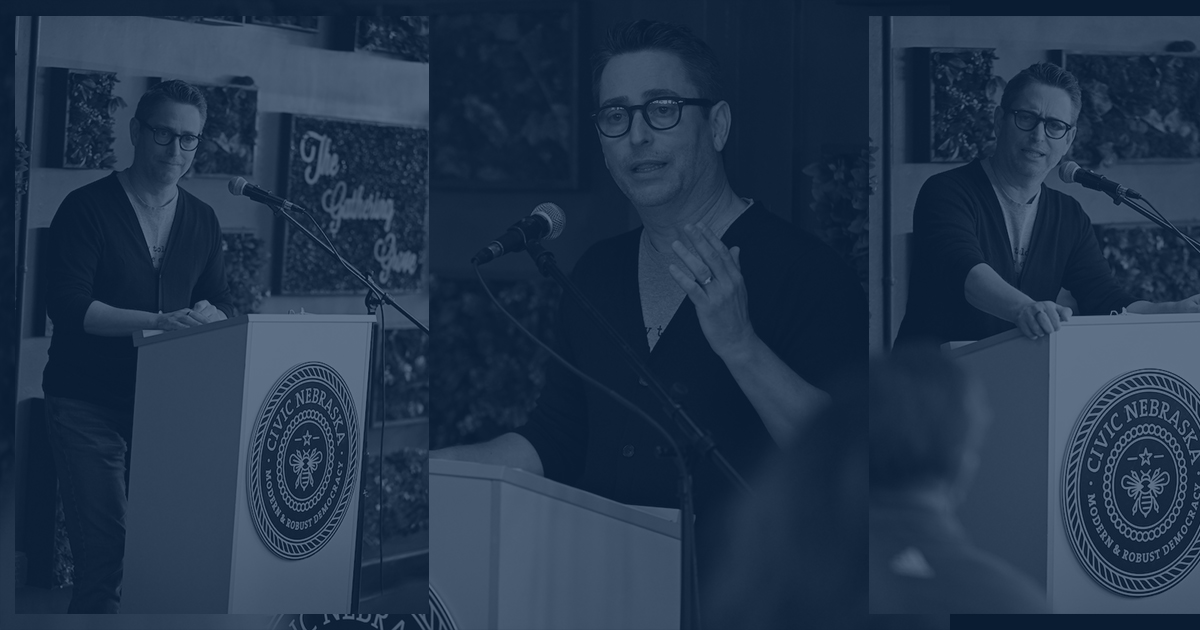
On Nov. 15, 2025, Civic Nebraska convened Civic Saturday: These Truths at The Gathering Grove in Lincoln, Nebraska, where National Civic Saturday Fellow Steve Smith delivered the following “civic sermon.” Listen to audio of the full gathering here. For more information about Civic Saturdays and to revisit past gatherings, click here.

Like we do so often at Civic Saturday, let’s start with a simple exercise. This one is just yes/no: Please raise your hand if you’ve seen or heard of the Peacock series Poker Face.
(Several hands go up)
OK, we have a few fellow travelers here. Good deal.
For those who don’t know Poker Face, it’s about a woman named Charlie Cale, a scruffy, chain-smoking, endlessly wandering do-gooder played by Natasha Lyonne. Charlie’s character has a gift: She can always tell when someone’s lying, and she’s never wrong about it.
It’s her superpower. At one point in every episode, Charlie will pause mid-conversation and say one simple word when her lie detector goes off.
She goes: “Bullshit.”
I promise that’s as blue as it’s going to get today.
Well, Charlie gets into a lot of trouble because she can’t help but call out the BS. And so, over and over, Charlie crashes headlong into other people’s invented realities – the ones that they’ve built to cover up their bad behavior.
It’s a good show. Check it out.
We could use a few Charlie Cales in public life, couldn’t we? Imagine if, every time someone in power told a whopper, someone in the room instantly called them out.
But since we don’t have that luxury, we have to do this work ourselves. We have to learn to recognize the complex, well-funded, and poll-tested lies that shape our public life.
What lies, you ask? I mean, I only have about 20 minutes. So, in the interest of time, let’s do some notable public falsehoods during my lifetime.
We are winning the war in Vietnam. We did not exchange arms for hostages. I did not have relations with that woman, Ms. Lewinsky. Saddam Hussein has active nuclear and chemical weapons programs. Climate change is a hoax. Obamacare will create death panels.
More? OK.
Barack Obama is a secret foreign-born Muslim. The 2020 presidential election was stolen. Lockdowns and mandates killed more people than COVID. They’re putting litter boxes in schools. JD Vance has a fondness for couches. Haitian immigrants will eat your dogs and cats.
Those are just the ones off the top of my head. It does beg the question: How much lying can a democracy take before people lose their sense of reality? Truly, fully, lose it? And what does that mean for all of us?
Well, let’s talk about it. Today is a good day to talk about truth and untruth.
First, let’s look at at least one thinker from a bygone age – who wouldn’t be surprised by anything that we’re going through now.
Then, let’s consider whether we’ve arrived at a place they ultimately feared: a world detached from shared fact.
And finally, let’s explore how we can navigate, as citizens, this age of untruth.
OK. Let’s start with some deep thoughts.
Few philosophers examined the relationship between truth and freedom as closely as Hannah Arendt did. She was one of the most influential political theorists of the 20th century. She fled Nazi Germany for America and tried to understand how societies come to prefer comforting lies over difficult truths.
Notably, Arendt says that politicians have always lied. There was no blessed time when elected leaders were transparent and honest. In every age and system, power and deception are inseparable. Rulers have to do two things on the regular: Conceal their failures, and rewrite their history.
Arendt also believed that public lies were an existential threat, especially in Western democracies. Because in a democracy, truth is not a luxury. It’s the very scaffolding that holds up our collective life. And when citizens are conditioned to stop caring what’s real, our framework of freedom starts to sway.
Arendt called this defactualization. It starts when a leader decides that certain realities are too inconvenient to acknowledge – a failed war, a broken promise, a painful inequality. The lie, then, begins as a shield. But the longer it’s held up, the longer it goes on, the more it shapes the liar’s world. Eventually, even the deceivers begin to live inside their own falsehoods. And they force everyone to play along.
The cost to all of us – the people – is profound. We start to lose contact with true fact, and when that happens, the sense by which we get our bearings in the real world – the common sense – is destroyed.
Think about that phrase: common sense. The president says it a lot. But to people who study truth and untruth, it just means, quite literally, the sense we share in common – our ability to perceive the same world together. Without it, everything is chaos.
World history is littered with examples of regimes waging war on the common sense. World history is also full of warnings – about how someday, technology would amplify and accelerate this outsourcing of critical thought. Today, social media gives us access to vast communities that reassure us we’re right, even when we’re catastrophically wrong.
And that can open up quite the Pandora’s Box. When we start to see and hear things we once thought were intolerable, some of us shrug and say: “Well, everyone’s doing it, so it can’t be all bad.”
Of course, many of us will also put up our hands and say: “That isn’t right.” But the fact that intolerable acts are now even debatable is what Arendt meant by the threat. Without a shared sense of what’s factual, our public life becomes a never-ending contest of fantasies. We parrot the words and phrases we see in our chosen media.
Most tragically, we lose our ability to think. Thinking – the essence of freedom – begins to fade away.
So, what do we think, friends? Have we arrived at that point in America?
When most of us picture a free society falling, we often conjure up the old movie reel of tyranny: Jackboots striking cobblestones, fascist banners snapping against gray skies, a single figure shouting from a balcony to orderly rows of identical salutes.
Today’s generation of autocrats doesn’t necessarily seize power with tanks and guns. Instead, they deploy “alternate facts” to hollow democracy out from within. It’s a lot cheaper, and a lot less bloody.
Hungary. Turkey. India. Russia. Once, their leaders came to power through democratic elections. But once in office, each of them mastered the same choreography: Rewrite the rules, pack the courts, weaken the press, declare critics enemies of the state.
Don’t outright ban the opposition – just overwhelm them with untruths. Don’t abolish elections – just rig them, restrict them, and flood them with lies until the results are meaningless. Don’t forcefully silence journalists – just bury them under false noise, and then dare to call them liars. The Germans’ term for this was lugenpresse – the “lying press.” What do we call it today? Right. Fake news.
This is autocracy for the digital age: Convincing citizens that democracy still exists, long after its actual force and meaning have been gutted.
America’s slide has happened slowly, over the years – through apathy, overload, distraction, and the persistent memory-holing of objective truth. It’s happened through the steady numbing of good and trusting people, many of whom now no longer have the mental framework to separate fact from fiction.
This truth hurts, doesn’t it?
But yet – yet! – there is still reason for hope. The United States is not Turkey or India or Hungary or Russia. We tend to underestimate the deep tradition of dissent and resistance in this country. It’s as old as the hills. It’s in our DNA. And we will not be brought to heel as swiftly, as totally, or as easily as those other nations.
That’s to our credit. But knowing this is only the first step. The harder question, the one we’ll tackle next, is: How do we push back?
Well, I do know this. Restoring a shared democratic reality will take more than simple fact-checking.
You can correct a lie a thousand times, and it will still outrun you on the next click. Snopes and PolitiFact won’t save the Republic. We’re going to need to look deep inside ourselves – each of us – and seek a return to patience, humility, and shared meaning.
That won’t be easy. Self-government wasn’t designed to be a perpetual shouting match. It requires what’s called the unforced force of the better argument – the slow work of reasoned persuasion among equals.
Our first job as Americans – all of us – in this era is to reclaim and help others reclaim that slow work.
We’re streaming live right now to central Nebraska, where Civic Nebraska’s current fellows, taking part in our Idea of America Fellowship, is gathering. I want to take a moment to highlight their work. The Idea of America Fellowship brings together emerging leaders from across Nebraska to wrestle with the big questions, including Who are we as a people? They’ve been in deep conversation about citizenship, belonging, and the responsibilities that come with freedom.
They’ve discovered what we all eventually learn when we practice democracy in earnest – that it’s something we build, one conversation, one relationship, one act of courage at a time. So thank you, Fellows, for doing that work, and for helping all of us see what democracy looks like when it’s alive and in motion.
Our Fellows are also learning to de-romanticize the idea that first is best when it comes to information. Today, we prize instant opinions, as if speed somehow equals insight. But as we’ve said, democracy requires deliberation. It demands we wait, listen, consider, and, only then, decide.
So the first step is to regain our deliberative powers. So that the unforced force of the better argument can lead us forward, again.
Second, we must rebuild consensus reality. Not uniformity, not rigid conformity, but a simple, shared foundation of fact. This is truly up to us, friends: The old top-down, legacy media information order is gone. Americans don’t just consume information anymore; we’re constantly producing, remixing, and reframing it. Everyone is a storyteller, and every story competes for our attention and our belief.
On its face, that’s democratic. But it also means facts themselves are being shaped in real time by forces that don’t always hold up to scrutiny – forces like emotion, identity, or the potential to go viral. Those old institutions that once mediated truth – universities, newsrooms, even churches – they’re no longer our anchors. They’re actors in this same, chaotic, never-ending play.
In the face of this, all of us – institutions and citizens alike – can model healthy discernment – to teach media literacy as a form of civic resilience. If a lie can circle the globe before the truth puts on its shoes, then we have to build resilient and powerful networks of trust.
Sounds great, Steve. How do we do that?
Well, like most things, we start locally. We start by scrutinizing how we talk to one another. When we disagree, do we automatically assume bad faith, or do we seek understanding? When we encounter something false, do we rage, do we name-call, or do we seek to clarify?
Because in this extraordinary time, every conversation is, one way or another, a debate over our nation’s survival.
I’ll be honest. Standing here with you today, that sounds really hard. It’ll probably get harder.
But that doesn’t mean we give up. It means we get practical.
The first step in defending shared truth is a pause. Just a breath before we react, repeat, or share. That pause creates space for judgment to catch up to emotion. And in that moment, we can ask ourselves: Who’s saying this? What do they want me to believe? What do they get if I do?
Today’s lies spread fast, not because people are inherently evil, but because people are busy. And, most of us want to trust what we see, especially when it fits what we already feel.
That’s why it matters how we respond when we hear something untrue. We can’t just say “That’s wrong!” But we can build what we communications types call a truth sandwich. You start with the truth, address the lie briefly, and then end with the truth again. That way, reality has the last word.
Here’s what that sounds like in real life:
Someone says, “The election was rigged.”
You say, “Actually, elections in this country are run locally by Republicans, Democrats, and independents working side by side. Do mistakes happen? Sure. But dozens of audits have found no evidence of widespread fraud. Our system held, and it held because people like you and me cared enough to make it work.”
That’s a truth sandwich. It’s steady, it’s factual, and it invites the listener back into reality – without humiliation.
This approach isn’t foolproof, but it’s relatively effective because shame and shouting don’t change minds. Connection does. Our goal isn’t to “own” anyone or win every argument; it’s to keep the shared world intact. So when you engage this way, you’re modeling democracy in miniature, with things like patience, good faith, and respect for the evidence.
Meanwhile, we can all cut back on the endless scroll of outrage. We can seek out information that values verification over going viral. We can read local news, talk to real people, and remember that algorithms aren’t our friends; they’re just mirrors of what already stirs us up.
This sounds too simple for a complex world, I know. But for centuries, that’s how our shared reality has survived: not by silencing every lie, but by refusing to let them define the conversation.
So when you hear something that sounds off, take that breath. Start with what’s real. Stay gentle, stay factual, and, above all, stay human.
And when the moment comes – because it always does – for you to decide whether to react, repeat, or repair? Choose repair.
Multiplied by the millions, that’s how we hold the line.
Charlie Cale, the reluctant lie detector of Poker Face, keeps running – because she can’t bear to live inside a lie.
Every time she exposes one, she pays a price. Truth-telling in Charlie’s world is dangerous.
So it is, in ours.
Democracy needs voters and laws. But more than that, it needs witnesses. People who keep the record straight, even when it’s inconvenient. People who can say, with courage, “Well, that’s not true,” and then have the compassion to keep the conversation going.
In an age of untruth, this is what we are called to do. We’re not called to eliminate lying, because we can’t. The question is whether we can build a society that is resilient enough to resist it.
This can’t be optional. Freedom and truth are inseparable. A citizen who cannot discern what is real cannot meaningfully consent to be governed. And, our shared democratic reality cannot give way to a war of the worlds. It must be a conversation about the one world we actually share.
So, let’s keep that conversation alive. Let’s practice the quiet, daily art of honest attention – the kind that sees the world as it is.
Let’s become, each in our own way, small lie detectors. And when that easy falsehood beckons, or when that comforting conspiracy hums its familiar tune, let’s remember Charlie’s gift … and her burden.
Let’s pause, take a breath, and whisper to ourselves with humility and courage:
“Wait. That’s not right.”
And then – with our eyes open, our hearts steady, and our feet firmly planted in what is real – let’s move forward together, to do what truth always demands: rebuild, repair, and begin again.
Thank you.