

It’s not just an American thing. Today, people around the world are questioning whether their political systems are equipped to handle fast-paced modern challenges. A new international survey from Pew Research Center offers one of the clearest recent snapshots of that sentiment, and for us Americans, it carries both warnings and opportunities.
The survey, released last month, canvassed 25 countries on attitudes about political reform. The results showed widespread dissatisfaction, large generational differences, and a complicated mix of hope and skepticism about the future.
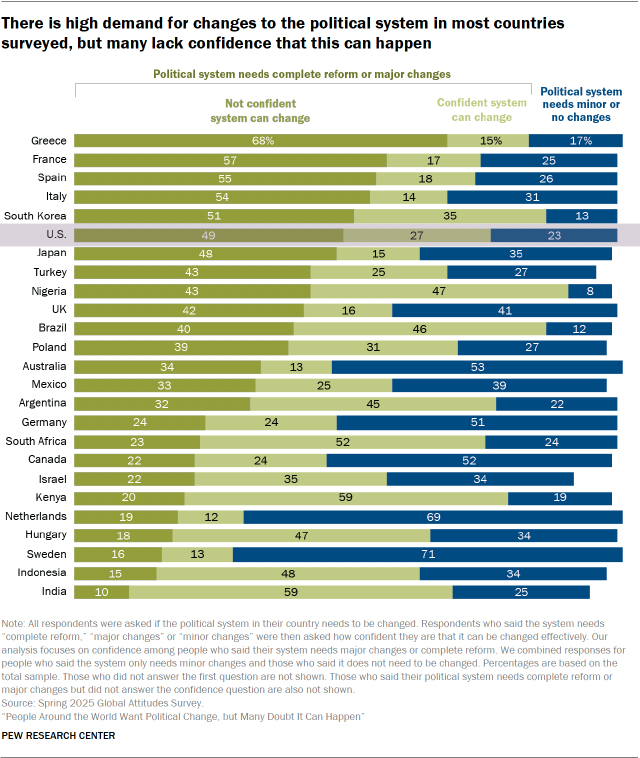
For our part, roughly eight in 10 Americans said that our nation’s political system either needs significant changes or a complete overhaul. That level of discontent places us among the highest in the world in terms of appetite for reform, alongside countries such as Argentina, Greece, Kenya, Nigeria, Brazil, and South Korea. Those are nations with different histories, institutions, and political cultures, but their citizens share a strikingly similar sense with ours that their governing systems are under strain.
In some ways, this level of dissatisfaction can feel destabilizing, but it’s also evidence that people are paying attention. Americans aren’t turning away from their political system; they’re saying, loudly, that it isn’t working as it should.
The survey also reveals what might be called a reform “belief gap.” In many countries, including the United States, people want change but doubt whether it can happen. That’s concerning – when citizens lose faith that their political systems can respond to public demands, cynicism and disengagement inevitably follow. That kind of disillusionment can erode trust further and, in some cases, open the door to wider anti-democratic movements that like to promise easy answers.
Our history offers a different possibility. When societies close the “belief gap” by demonstrating that meaningful reform is achievable, democratic systems can emerge stronger. Take the Progressive Era at the turn of the 20th century and the Civil Rights Movement in the 1950s and 1960s. Both periods were marked by widespread dissatisfaction, and that energy gave way to sustained civic action and institutional change. Reform seemed improbable before it happened. But then it happened, and it reshaped our nation.
The Pew survey further highlighted two significant divides that shape attitudes toward reform in the United States:
›› Generationally, younger adults are more likely than older Americans to say major reform is needed. This makes sense. They’ve grown up amid polarization, gridlock, and profound technological and social shifts, and they expect our institutions to adapt.
›› Politically, supporters of the party in power tend to be less supportive of reform than those in opposition. But this is not a simple partisan story. Even among Americans who believe most elected officials are ethical, 65 percent still say the system itself needs significant change. That’s a revealing figure, suggesting that dissatisfaction with democratic structures runs deeper than frustration with a particular leader or politician.
Of course, surveys alone don’t change things; people do. But information like this can offer a timely dose of clarity. In our view, Pew’s findings should be understood as a marker of where Americans are, both emotionally and politically. The direction from here depends on whether that demand is met with imagination, persistence, and action.
Moments like this have appeared throughout our history. Whether they become turning points depends on how seriously we take the signals – and what we choose to build in response.