
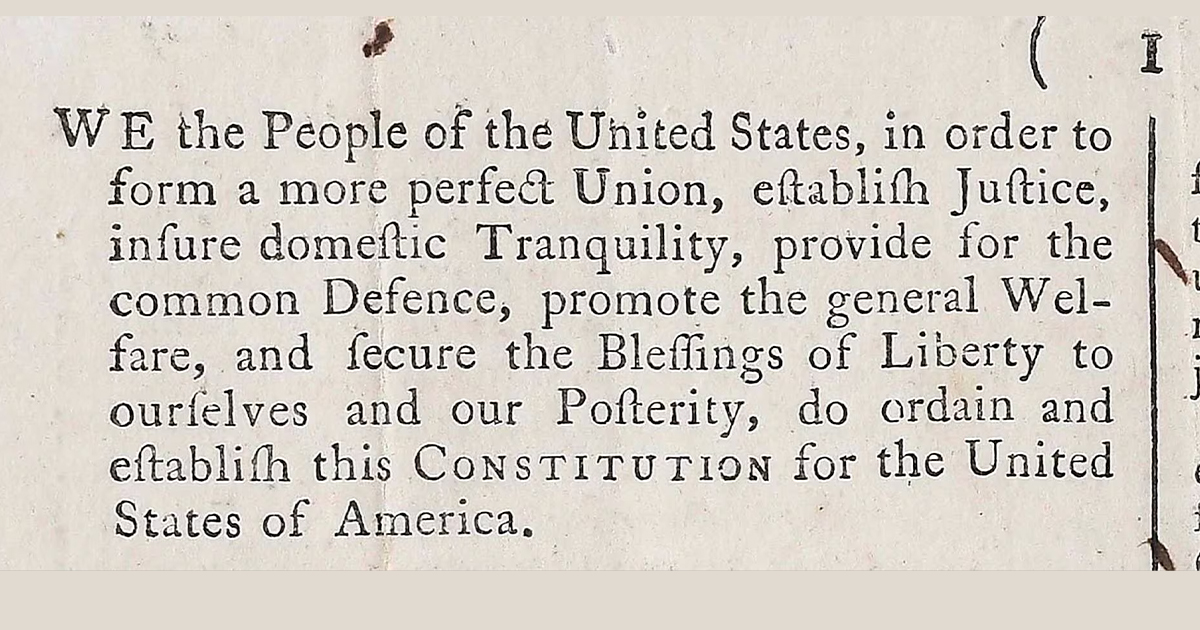
It’s Constitution Day! Time to brush up on your knowledge of the founding document that shapes our democracy. Two years ago, Civic Nebraska put readers to the test with our first-ever Constitution Day Super-Quiz. You passed with flying colors (we assume; we have no real way of knowing). So, we’re back with a sequel! See how you do, and check the answers at the end to learn more.
1) What was the last state to ratify the U.S. Constitution (before the Bill of Rights)?
a. Rhode Island
b. New Hampshire
c. North Carolina
d. Denial
2) Which article of the Constitution defines the powers of the executive branch?
a. Article I
b. Article II
c. Article III
d. Avengers: Infinity War
3) Before the 17th Amendment, how were U.S. senators chosen?
a. Popular vote
b. By state legislatures
c. By the President
d. Coin toss at midfield
4) Which Supreme Court case established the doctrine of “separate but equal”?
a. Marbury v. Madison
b. Dred Scott v. Sandford
c. Plessy v. Ferguson
d. Kramer v. Kramer
5) Which amendment changed the start dates of congressional and presidential terms, earning it the nickname “Lame Duck Amendment”?
a. Twentieth Amendment
b. Twenty-Second Amendment
c. Twenty-Fifth Amendment
d. The Groundhog Day Clause
6) Who was the only president to also serve as Chief Justice of the United States?
a. John Quincy Adams
b. William Howard Taft
c. James Monroe
d. Harold T. Stone
7) Which amendment abolished slavery in the United States?
a. Thirteenth Amendment
b. Fourteenth Amendment
c. Fifteenth Amendment
d. The Emancipation Proclamation
8) How many times has the U.S. House of Representatives chosen the president because no candidate received a majority in the Electoral College?
a. Once
b. Twice
c. Three times
d. Every election, if you ask Uncle Larry on Facebook
9) Which Supreme Court case required that criminal suspects be informed of their rights upon arrest?
a. Gideon v. Wainwright
b. Miranda v. Arizona
c. McCulloch v. Maryland
d. Pilgrim v. World
10) Which constitutional amendment guarantees that powers not given to the federal government are reserved to the states or to the people?
a. Ninth Amendment
b. Tenth Amendment
c. Eleventh Amendment
d. Forty-Seventh Amendment

ANSWERS
1) a. Rhode Island. Rhode Island was the last of the original 13 states to ratify, finally doing so in May 1790. It had initially rejected the Constitution, fearing centralized power, and only joined once the Bill of Rights was promised.
2) b. Article II. This article lays out the powers and responsibilities of the president and the executive branch, establishing the framework for how the presidency operates.
3) b. By state legislatures. Until the 17th Amendment (1913), senators were chosen by state lawmakers, not by the people. The change was meant to reduce corruption and increase direct democratic accountability.
4) c. Plessy v. Ferguson. In 1896, the Court upheld racial segregation under the “separate but equal” doctrine, a decision that stood until Brown v. Board of Education overturned it in 1954.
5) a. Twentieth Amendment. Ratified in 1933, this amendment moved the start of presidential terms from March to January, reducing the “lame duck” period between election and inauguration.
6) b. William Howard Taft. After serving as president (1909-13), Taft became Chief Justice in 1921, the only person to hold both offices. He even preferred his judicial role to the presidency.
7) a. Thirteenth Amendment. Ratified in 1865, this amendment formally abolished slavery throughout the United States, enshrining emancipation into law after the Civil War.
8) b. Twice. The House picked the president in 1800 (Thomas Jefferson over Aaron Burr) and again in 1824 (John Quincy Adams over Andrew Jackson, in the so-called “Corrupt Bargain”).
9) b. Miranda v. Arizona. In 1966, the Court ruled that suspects must be informed of their rights to remain silent and to legal counsel – hence the “Miranda warning” still heard today.
10) b. Tenth Amendment. Ratified in 1791, it reserves all powers not delegated to the federal government to the states or the people, reflecting the Constitution’s balance between federal and state authority.
Whether you aced it or guessed your way through, the lesson is this: our Constitution is the foundation of our shared civic life. Constitution Day is a chance to celebrate, yes, but also to reflect on how each of us can carry forward its ideals. After all, the Constitution doesn’t just belong to history. It belongs to us.