
Living in Nebraska means living in the middle of the continent – and the middle of the American story. The Great Plains is where the coasts send their weather, their trends, and, often, their assumptions. From here, we often see how forces meet and mingle, and sometimes, how they clash.
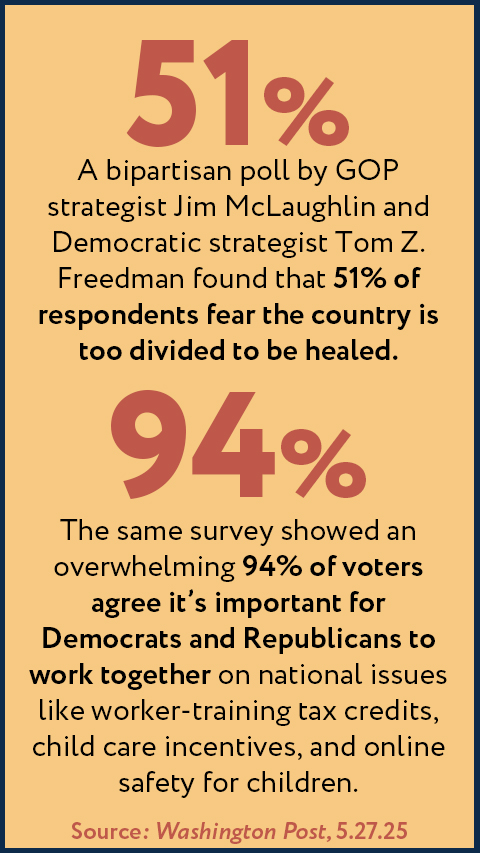
It’s helpful in times like these, when the dominant narrative from corporate media is all about how we are hopelessly divided. This narrative tends to over-represent in public opinion – recent polling shows Americans feel more divided than at any time in recent memory, with online outrage and mistrust crowding out reasoned conversation. Over half of respondents (51 percent) in a bipartisan national survey said they fear the political chasm has grown too wide to heal. Yet, that same survey showed that nearly everyone – a whopping 94 percent! – still wants Democrats and Republicans to work together on common challenges.
From here in the nation’s center, we can see how that manufactured gap can corrode trust and make solutions more challenging to reach. So maybe our so-called “Midwestern sensibilities” – taking a beat before acting, valuing hard work and fair play, accepting sacrifice for the greater good – can be instructive here. These collective habits are tested ways to slow the temperature, listen longer, and build agreements that can last.
Our collective mindset has grown from our shared experiences. Neighbors leaning on one another through long winters, failed crops, and unpredictable markets. Churches, town halls, and school gyms were where problems got worked out face-to-face. Survival depended on listening longer, holding your tongue a little more, and giving others the benefit of the doubt. Of course, we’re not immune to the noise – more conversations now happen through screens than across porches. Rural populations have thinned, which has weakened our overlapping social ties. National politics is noisier, more distant, and less rooted in our towns and counties. And as mentioned, our media diet rewards the fastest, hottest take instead of careful thought.
Still, the “Midwestern sensibility” is a practice, one we can keep alive by living as if we already have it, and by refusing to let the loudest, quickest voices drown out the steady, constructive ones.
What’s all this about?
Geography shapes our character. We know what it is to wait for the crops to grow, for the snow to melt, for the river to rise. We understand patience, we value steadiness, we measure our words, and we keep an eye on the horizon. Those are well-tested habits of survival in a place where the sky is half your view.
Here, we feel the pull of our country from every direction. This vantage point can be powerful. From Nebraska, we can see the country not just as red and blue blocks on a map, but as a patchwork of people who depend on one another more than they realize. We notice the connections between markets in Chicago, ports in Los Angeles, and the grain elevator down the road. We see how federal decisions ripple through county courthouses. And we see how local acts, both good and bad, can add up to something much bigger.
Nebraska’s political culture reflects this. We value local control. We expect straight answers. We hold fast to the belief that our communities can work things out if we’re given the chance. That doesn’t mean we agree on everything; far from it, in fact. But it does mean there’s a deep well of belief in self-governance here – a belief that’s worth defending.
Our spot on the map – however you might define the map – is an opportunity and a responsibility. We in Nebraska have the chance to model a way of doing politics that isn’t built solely on outrage or spectacle. We can be a bridge between two very different American realities, but we have to put in the effort.
What does that look like?
We can start by listening to people whose lives are different from ours. Listen to understand their stakes, their fears, and their hopes. We have to earn trust across divides – geographic, political, and cultural. That takes showing up in places where your message might not be popular, and sticking around long enough to prove you mean it.
Next, we must understand the pace of change. Some wins will be quick. Many will be slow. That’s not because people here lack urgency. It’s because the middle values proof over promises. Demonstrate that your idea works on a small scale, and you’ll find more people willing to try it on a larger one. Push too hard without building that proof, and you may set yourself back years.
Finally, we must be willing to invest in relationships that aren’t immediately transactional. Nebraska is a place where your reputation is your résumé. People remember if you showed up when there wasn’t anything in it for you. They recall when you helped solve a problem without demanding credit. That kind of quiet capital is worth more than any one campaign or project.
The middle of America has its share of political fights, ideological divides, and difficult histories. But living here in our double-landlocked state means you learn to keep going. You keep planting crops after a hailstorm, you keep rebuilding after a flood, and uou keep gathering at the café, even when the conversation gets tense.
That persistence is a civic asset. And it shows you believe that your neighbors are worth the effort and that you see the value in making your community stronger, fairer, and more connected, even when it would be easier to retreat into frustration.
There’s a steadiness here that the rest of the country could use more of. It comes from knowing we’re all tied to one another, no matter how much we might argue about the details. If one wants to lead here, they must embrace that interconnectedness – see the threads, strengthen them, and when they fray, help mend them.
From our unique vantage point, we can look in every direction and see challenges ahead. We can also see possibilities. Nebraska offers both in equal measure; the question is whether we have the will to face the first so we can reach the second.
For those willing to try, there’s no better place to start than right here – in the middle of everything.
