
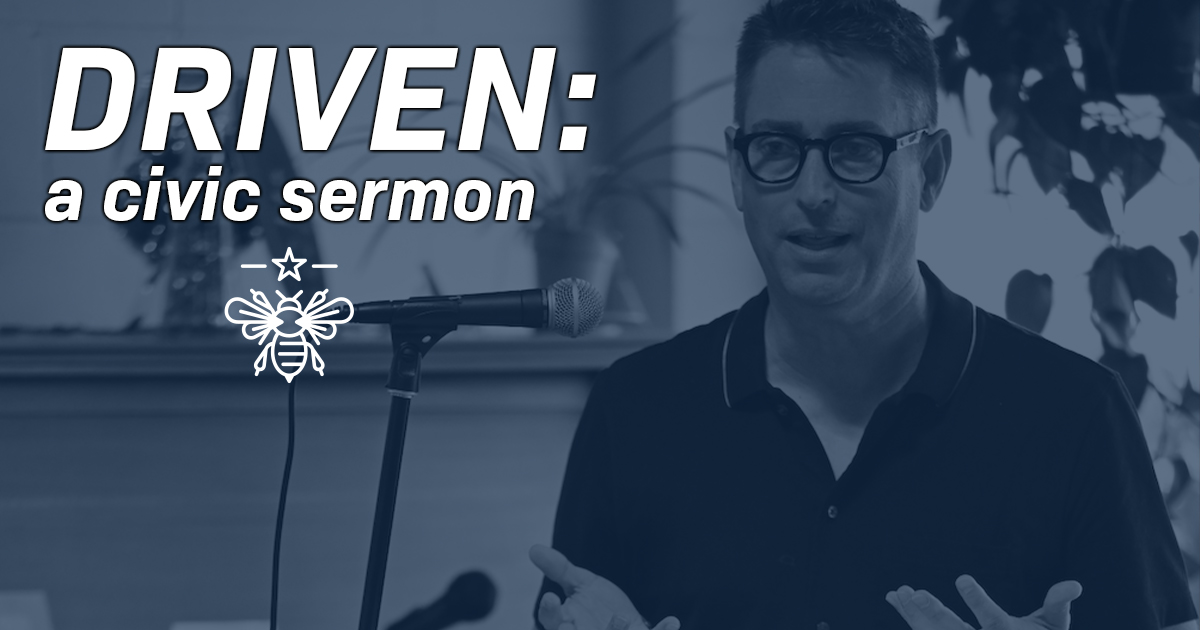
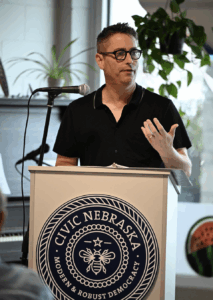
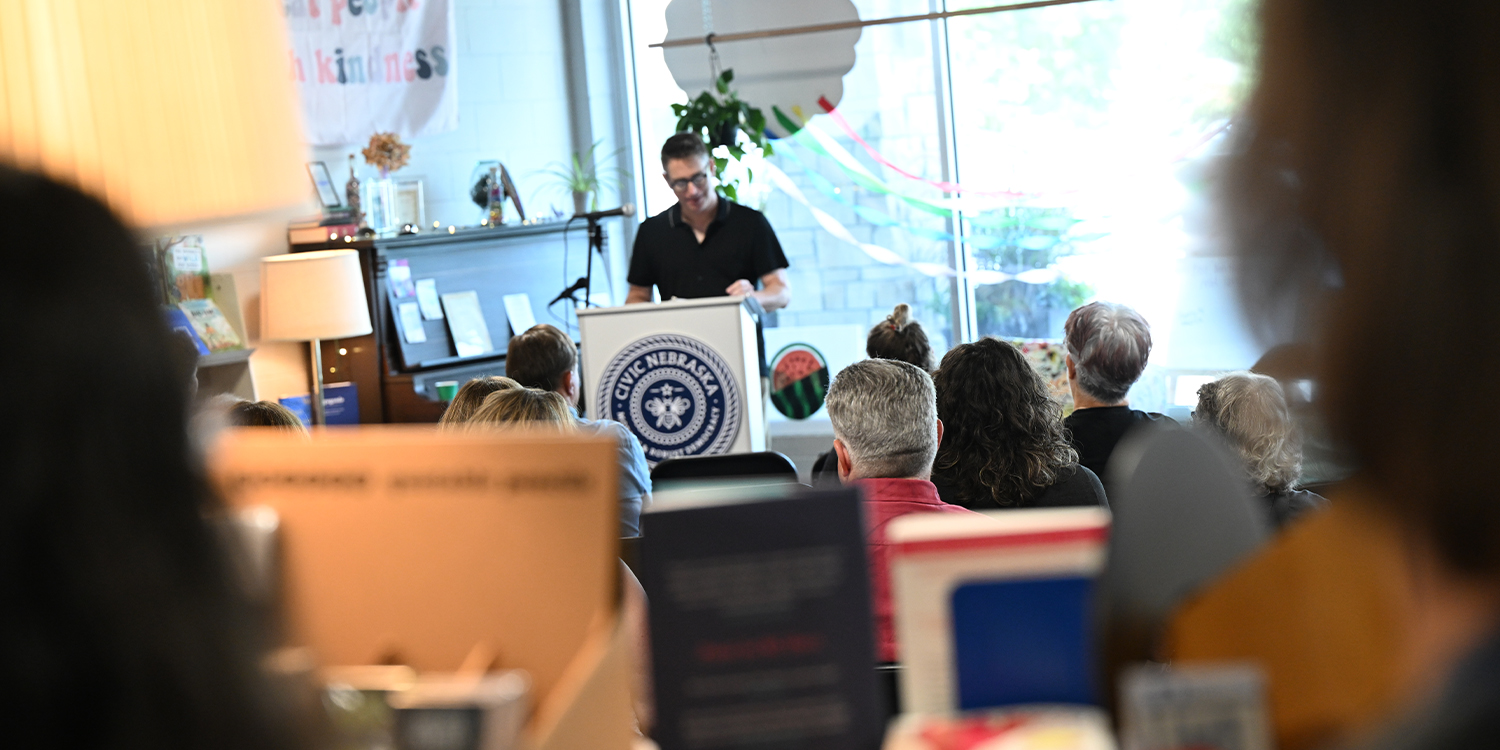
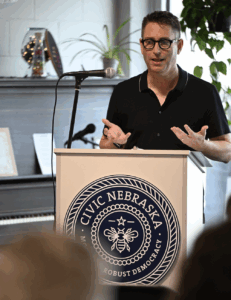
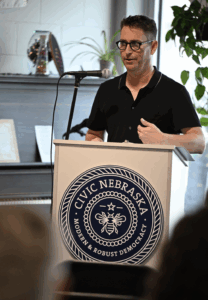
On July 19, 2025, Civic Nebraska convened Civic Saturday at Sower Books in Lincoln, where National Civic Saturday Fellow Steve Smith delivered the following civic sermon. Listen to the full gathering here. To learn more about Civic Saturdays and to browse sermons, readings, and music from past gatherings, click here.
* * *
Thanks, everyone, for being here today. To start us off, let’s do a quick exercise. Feel free to raise your hand when what you hear applies to you. Sound good?
Here’s the question: How did you get here today?
I don’t mean your exact route, from start to finish. I mean your mode of transportation. Did you walk? Or ride your bike? Maybe take one of those Lime scooters for a spin?
How about public transportation – did StarTran get you here? Anyone?
OK, then. Who drove here? Who got here in a motor vehicle?
(Steve raises his hand, along with a vast majority of the audience.)
 Well, there we have it. Most of us drove. That’s not a big surprise – I mean, when considering where to host this gathering, one of our main considerations was the amount of parking our host could offer. So, from the looks of things, today’s discussion should be relevant to all of us.
If we’re like most Americans, we spend about an hour a day in traffic. Add it up, and that’s nearly 400 hours a year – or two and a half solid weeks – inside our glass-and-metal road machines. Some of us commute. Others shuttle kids or groceries. Some of us sit in our driveways on the phone, or in a parking lot, scrolling through our texts. But there we are: Alone, often, and increasingly stressed or agitated. Enclosed in an expensive bubble with just our thoughts, or maybe a podcast, or maybe the radio to keep us company.
Now, in the democracy-building business, we put a lot of thought into Third Spaces – those places between home and work where we gather, connect, and engage in community life. These spaces – places like coffee shops, libraries, parks, town halls, and, yeah, bookstores— foster the informal interaction and trust that are essential for a healthy small-d democratic society.
Anyone with self-awareness knows that the automobile has, for better or worse, become a robust third space in America. It’s a peculiar, rolling, in-between space, where our civic sensibilities can either come to life … or wither.
And yet when we’re talking about building democracy, we rarely discuss this space – metaphorically or literally. We often dismiss our commutes, errands, and car trips as merely getting from Point A to Point B, nothing more and nothing less.
Well, this morning, I invite us all to think about what happens inside ourselves when we drive. Maybe, just maybe, that might reveal more about our American way of life – and our hearts – than we first realize.
First, let’s talk about how we got here (metaphorically, not literally). Second, let’s talk about what happens to us, for better or worse, when we get behind the wheel. And finally, let’s talk about making this third space better.
First off: How did we arrive at this place?
Here’s a speed history of the American automobile.
At the beginning of the 20th century, cars in America were luxury novelties. That changed in 1908 with the introduction of Henry Ford’s Model T and, five years later, the innovation of the assembly line. That lowered the cost of cars and made them accessible to the average American. Within a decade, cars were rapidly reshaping American daily life: roads were expanding, cities were sprawling, and roadside culture was beginning to emerge.
Then came the post-World War II boom, which cemented the car’s place in the center of our national life. This is my parents’ era: My dad’s first car was a ‘57 Chevy; I swear I never heard him talk about me or my sisters in that wistful, loving way he used to talk about that car.
For much of the 20th century, the government reinforced car culture at nearly every turn: Federal and state investment in roads exploded after the war, resulting in tens of thousands of miles of interstates. With that, the suburbs boomed – neighborhoods and business districts intentionally designed for cars, not pedestrians.
Zoning laws separated where we lived from where we worked and shopped, meaning we had to drive to get anywhere. Suddenly, the car was no longer optional; it was essential. It is worth noting that this shift was a major force of inequality, as well – those who had cars and trucks were able to solidify their position on the economic and social ladders. Those who didn’t? Well, they got left behind.
Right up to today. Over the past four or so years, since the pandemic, we’ve become even more insulated in our vehicles. They’ve become a sealed personal habitat, a space of perceived safety and control in a chaotic world.
We work in our cars. We eat in our cars. We stream TV shows, have private phone calls, record testimonial videos about politics or personal grievances — all from the front seat. The car has become our office, our stage, and our fortress.
It shouldn’t surprise us, either, that our vehicles have become bigger, harsher, and even more militarized in appearance lately. The sleek curves of older sedans have given way to blocky, intimidating grilles and sky-high truck hoods. When I see these monster trucks, I feel like it’s less design than it is a posture: After two decades of war in the Middle East and an ambient sense of insecurity at home, our national aesthetic has taken on the trappings of toughness and aggression. In my view, these brutal-looking vehicles reflect a society that increasingly views the outside world as something to be defended against, rather than something to be part of.
Fear. Isolation. Loathing.
This is also reflected in the way we organize our lives. A bad example, but it’s the one I have: Before the pandemic, I used to walk to the downtown Panera once a week for a bagel and some coffee. It was a small ritual — an excuse to be in the world, to move at human speed. But, a few years ago, that store closed. Panera decided all their new locations needed to have drive-throughs. So the closest Panera now is on 60th and O Street, between a strip mall and a row of parking lots.
I work on 13th Street, so I guess I could drive there. But that’s just it – I’d have to drive there.
And that’s enough to put a guy in a bad mood.
That’s the second thing I want to discuss: What driving does to us, whether we’re rolling around in a Prius or a Hummer.
The truth is, driving is one of the most psychologically complex activities humans can engage in. The moment we get in and start the engine, something in us shifts. Our minds enter a different mode. Of course, as we accelerate toward our destination, we’re moving through physical space — but get this: We’re also moving through emotional, moral, even spiritual terrain. It’s here that things like fear, status, anonymity, insecurity, and aggression start to bubble up.
I’m seeing some nods.
Most of all, driving gives us the illusion of control, even as it demands real-time processing of vast amounts of visual, auditory, and hand-eye cues. Then, ironically, the more experienced we become, the more we believe we’ve mastered the art of driving. We begin to operate our vehicles with less consciousness and awareness.
It’s true. We do. But the problem is that our brains are not as adept at multitasking as we like to think. The average driver believes that they are better than most other drivers on the road – which, of course, is a statistical impossibility. We get overconfident, which dulls our attention and leads to risky behaviors like texting or eating while driving. In reality, we’re only a split-second lapse of awareness away from a painful – perhaps even fatal – lesson.
 At the same time, the very way that traffic works creates an environment that’s built for misunderstanding one another. Behind the wheel, we’re enclosed in metal and glass, isolating us from the direct social cues that govern everyday interactions. Things like eye contact, our tone of voice, our facial expressions. This leads to the loss of self-awareness and accountability; we are, all of us, more likely to behave aggressively or selfishly because we feel anonymous and protected.
So, we honk when we wouldn’t shout, tailgate when we wouldn’t crowd someone in line, and gesture obscenely when we would never curse out a stranger face-to-face. Over the years, I’ve heard otherwise calm and courteous individuals admit to moments of road rage that, in retrospect, feel like out-of-body experiences.
I do it, too – maybe worse than anyone here. I mean, I consider myself a fairly easygoing and tolerant person, but cut me off in traffic and I will rain hellfire down upon you. I don’t care if you have kids in the car.
Or, if it’s clear you’re bigger than me, I’ll call you a colorful name under my breath.
The point is, dehumanizing other drivers is practically our national pastime. Especially when another person’s vehicle serves as a proxy for our prejudices and ancient hatreds. As we drive through space together, we’re also navigating a complex social drama – but without the basic tools and cues that usually keep our behavior in check.
So, we start to see our cars – and, by extension, our driving – as reflections of ourselves and our identities. A Prius can convey environmental awareness, or draw sneers about “virtue signaling.” A pickup can suggest freedom and independence, or dominance and aggression. A sports car can project youth or virility, but also foolishness. An old beater can represent thrift and functionality, but also can evoke accusations of laziness. A luxury SUV might be a suburban status symbol, or it could conjure up resentment against that entitlement, not to mention the hogging of finite resources.
When people tie their sense of self to their vehicle or their driving style, any perceived challenge on the road can become a threat to their precious egos. Being cut off or passed suddenly becomes a moral affront. Increasingly, traffic disputes in America are stemming from perceived slights, status struggles, and unacknowledged insecurities, rather than who ran the red light or who didn’t look before changing lanes.
These dynamics play out in all sorts of ways, whether they’re subtly class-based, or gendered, or racialized, or what have you. Cars and drivers are subjected to ill-informed judgment, scorn, or righteous indignation. Our cars become both shields and stages, hiding us while also projecting our chosen image that shows we’re different from everyone else on the road. More important.
As Third Spaces go, our roads are, on balance, kinda crummy and toxic. And so there lies the challenge. Our roads diverge from the path of healthy democracy.
Unlike traffic, democracy is prosocial. It requires us to slow down, to notice one another, to recognize dignity, and to practice radical empathy. Our shared civic life depends on the kind of human-centered speed that lets us catch each other’s eye, share space, and take turns.
Without that shared intentionality, that mindfulness, we race right past one another, don’t we? And we risk turning our streets and our society – our society – into a gridlocked, hostile land where no one ever truly arrives.
And yet, there is still hope — even if it feels like our collective empathy is stuck in traffic.
That’s the last thing I want to talk about here. Show of hands: Anybody run into construction on the way?
(Laughter and raised hands from more than half of the audience)
Yeah.
The other day, I was driving north on South 17th Street here in Lincoln. This stretch has been getting a major resurfacing this summer. It was almost done, but there were still a few spots where the road narrowed down, and a line of orange traffic cones nudged us all into one narrow northbound lane.
We’ve all been in a spot like this, haven’t we? The space we’re driving in dwindles down up ahead and then ends, and we all must find a new space at some point soon. Or, more accurately, we must zipper merge.
Do we know the term zipper merge? The best way to say it is: I go, then you go; You go, then I go.
Zipper merging is not jumping the line or letting others cut. It’s about timing, fairness, and collective benefit.
But it only works when everyone understands the system, understands its benefit to everyone, and then agrees to cooperate. … So, naturally, that’s not what happens. Lane closures are among the most contentious spaces in America today.
Why? Well, partly because zipper merging asks us to resist our instincts; either to merge early out of overzealous politeness, which only creates more congestion, or to judge those who correctly – correctly! – drive up to the merge point as selfish cheaters.
This is a powerful metaphor for civic life: When we trust one another, take turns, and resist the urge to get ahead at others’ expense, everyone moves forward more smoothly.
I go, then you go. You go, then I go.
We’ve all seen that play out, too. There’s a danger in focusing too much on our isolated individualism when we’re in traffic. We can forget that just as often, we see, commit, and experience regular acts of civic love on our roads.
When someone lets us merge with a kind wave.
When drivers take turns with grace at a four-way stop.
When someone stops for a pedestrian without being forced to.
When you roll down Main Street of a small Nebraska town, and a local resident waves from behind their front windshield as they meet you, even though they don’t know you.
These small, silent choices are acts of civic trust, and they remind us that our shared spaces function on norms as well as laws. When everyone participates in that spirit — when we defer to one another, when we leave space for one another, when we keep spaces safe and clear for one another — well, we all move along toward our destination more smoothly, don’t we.
I go, then you go. You go, then I go.
Civic life runs on norms. They form the invisible framework that holds our society together. When people honor these conventions, even when they’re not legally required to, it builds trust, cooperation, and social cohesion. It’s sustained by the small choices we make when no one is watching. To listen, to yield, to include.
These might seem like trivial decisions, but they form a quiet code of conduct that has endured for 249 years. It’s not just our laws that hold things together — it’s our unspoken agreements, our everyday courtesies, and our shared assumption that we’re all in this together.
That’s democracy. When we honor these small-d democratic values behind the wheel, then we can’t help but reinforce them beyond it — at the ballot box, in the neighborhood, in the shared spaces where democracy truly thrives.
So. If we want to preserve the integrity of our Republic, then we need to drive, and vote, and lead like we live in a community, not a convoy.
Let me leave you with this. You know how we often say, “I’m stuck in traffic”?
That’s not quite accurate. We are not stuck in traffic. We are traffic.
 That’s the truth that many of us don’t always want to face: This is not something outside of us that only we see, or react to. It’s us. Collectively, traffic is a system – one composed of our choices, our behaviors, our cooperation, or lack thereof.
American democracy is the same. It’s not something that happens to us. It’s something we do, something we embody. Our country is not just the politicians, pundits, or people who show up on TV. It’s you. It’s me. It’s the small decisions we make every day, to show up, to speak up, to let someone in. To listen. To look. To hear.
If we want less gridlock and conflict in D.C., or at our statehouse, or in our own communities, we need to stop blaming others – stop blaming “traffic” – and start taking responsibility for how we all move through this world.
Friends, we are the movement. We’re the ones who can wave people in. We’re the ones who can slow down so others catch up. We’re the ones who can choose cooperation over competition, and community over convenience.
That’s not easy. A strong civic life never is. But I know that we are capable of making that turn, not just in our cars, but in our hearts.
So, the next time you’re behind the wheel – or on social media, or leaning on the fence discussing the state of the world with a neighbor – maybe ask yourself: Am I contributing to the congestion? Or am I helping with the flow?
The next time you roll through the drive-thru, ask yourself: What might I discover if I got out of the car?
And the next time you say, Why doesn’t somebody do something? … Remember: You are somebody.
You’re not in traffic. You are traffic. And that means you are – you must be – part of the larger solution during this extraordinary time in our Republic.
So, let’s navigate carefully. Let’s speak kindly. And let’s show up fully.
By doing so, we’ll not only keep our precious democracy moving. We’ll keep it moving in the right direction.
Thank you.
