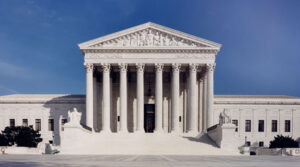

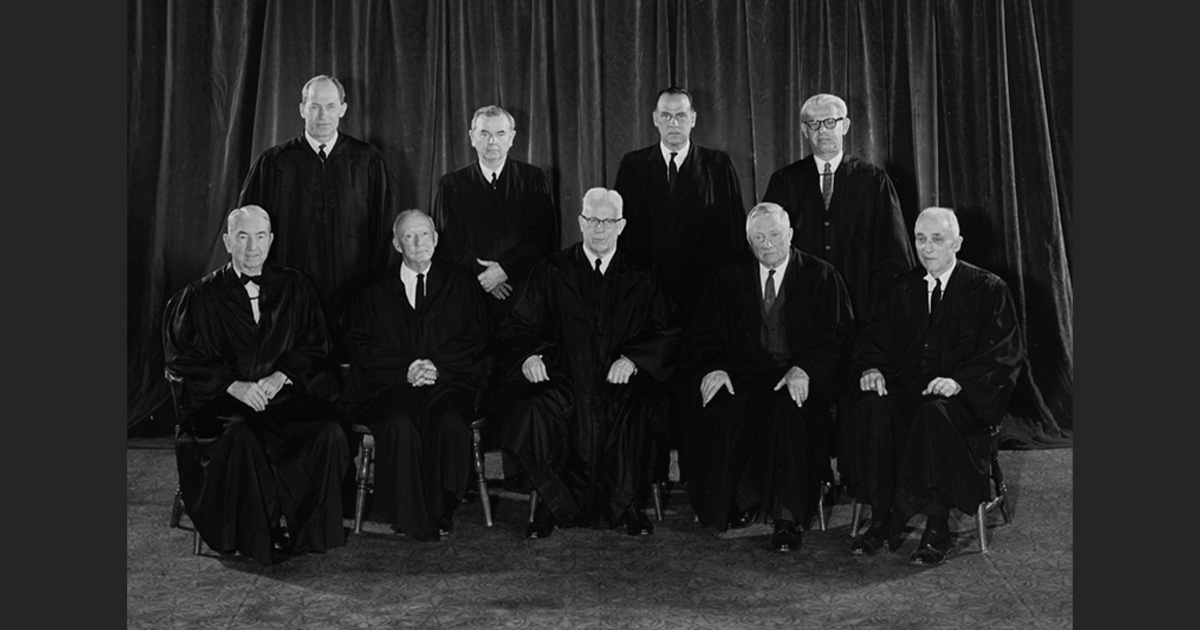
If you ask most Americans to imagine the role of the Supreme Court of the United States, they’ll likely envision a noble arbiter of fairness. A solemn institution standing above the political fray, protecting individual rights and ensuring justice for all.
It’s not hard to see why: Our national memory often centers on the Court of the 1950s and 1960s — the era of the so-called Warren Court, which gave us landmark decisions such as Brown v. Board of Education, Gideon v. Wainwright, Loving v. Virginia, and Miranda v. Arizona. These landmark rulings transformed civil rights, expanded due process, and affirmed the constitutional dignity of millions.
It’s tempting (and comforting) to believe this is the norm. However, when we widen our lens and look across the full sweep of history, a more complex story emerges. In moments of backlash or democratic regression, the Court has not always stood on the side of progress. In fact, it has sometimes played a decisive role in slowing — or even reversing — the hard-won gains of a more inclusive democracy.
This history matters today, in a moment when the Court’s decisions are reshaping the boundaries of our rights, freedoms, and civic participation. To fully understand how to build and protect democracy, we must understand what the Court is and what it can be when it reflects the will of a fully engaged and organized people.
Let’s begin with a sobering example. After the Civil War, Congress ratified three transformative amendments — the 13th, 14th, and 15th — to abolish slavery, guarantee equal protection under the law, and prohibit racial discrimination in voting. It was a bold, nation-defining attempt to reconstruct America around multiracial democracy.
But just as quickly as these rights were enshrined, they were eroded. And the Supreme Court played a key part.
In The Slaughter-House Cases (1873), the Court gave an incredibly narrow interpretation of the 14th Amendment, severely limiting the power of the federal government to protect citizens from state abuses. In United States v. Cruikshank (1876), it threw out the convictions of white supremacists who had massacred over 100 Black men in Colfax, Louisiana, claiming the federal government lacked authority to intervene in private acts of racial violence. And in the so-called Civil Rights Cases (1883), the Court struck down the Civil Rights Act of 1875, allowing private businesses to deny service based on race, paving the way for the Jim Crow South.
These decisions shaped the racial caste system that endured for nearly a century after the Civil War. They remind us that, especially in moments of democratic expansion, the Court can become a tool for retrenchment by reinforcing white supremacy, limiting federal power, and muting the voices of the very people the Constitution was amended to protect.
That’s partly why the Warren Court looms so large in our collective memory. It was a powerful exception to the rule and a unique moment when the Court aligned with a growing, organized, and morally righteous majority. Its decisions were not delivered from on high in a vacuum. They were the result of decades of grassroots work and civic pressure. They coordinated legal strategies, particularly by the NAACP Legal Defense Fund under the leadership of Charles Hamilton Houston and Thurgood Marshall.
In 1954, when the Court ruled in Brown v. Board of Education that segregated schools were “inherently unequal,” it was responding to the courage of Black families, educators, and organizers who had built the case both legally and morally for educational equity. When the Court expanded due process and the rights of the accused, it did so in the context of a nation grappling with fairness, police power, and civil liberties during a rapidly changing social landscape.
That era is rightly celebrated. It shows what’s possible when civic momentum and public consciousness reach the highest levels of our institutions. The Court can serve justice. It can be a backstop against injustice. But history teaches us that it only does so when we demand it, organize for it, and sustain the movements that give those rulings their meaning.
We are again in a period of democratic anxiety and political retrenchment. The Court’s recent decisions reflect that. In Shelby County v. Holder (2013), it gutted the Voting Rights Act of 1965, opening the door for a new wave of voter suppression. In Brnovich v. DNC (2021), it made it even harder to challenge discriminatory election laws. In Dobbs v. Jackson (2022), it reversed Roe v. Wade, ending a nearly 50-year constitutional guarantee of reproductive autonomy. Most recently, it has signaled a new era of privileging powerful interests under the guise of religious or corporate rights, often at the expense of vulnerable communities.
These decisions echo an earlier pattern: when rights expand too far for the comfort of entrenched power, the Court can often slam the brakes.
And yet, this is not destiny. As we’ve seen before, courts do respond to public pressure, cultural momentum, and civic clarity. When Americans are engaged, organized, and united around a just cause, the Court can reflect that. The lesson from the Warren Court isn’t that judges are inherently virtuous; it’s that civic strength can shape even the most insulated institutions.
Americans must not place blind faith in any one branch of government. We must believe in powerful citizenship. That means defending democratic norms and systems when they’re threatened, but more importantly, it means constantly creating the conditions in which democracy can thrive.
That includes teaching civic skills and literacy so that we all can critically evaluate our government. It includes organizing communities to advocate for fair maps, accessible voting, and a representative government. And it includes telling the whole, complicated story of our institutions – the moments when they failed us, and the moments when we rose up and made them do better.
The Supreme Court is not, and never has been, separate from the American story. It is part of our democracy. And like every part of our democracy, it can only live up to its ideals when we hold it accountable, and when we commit ourselves to the long, patient, people-powered work of justice.

Trump v. CASA: clarity of the stakes
The Supreme Court’s June 27, 2025, decision in Trump v. CASA is a powerful reminder that the Court is not a guaranteed safeguard for democratic progress. In the recent case, the Court sharply limited the ability of lower courts to block executive actions on a nationwide scale, making it harder to halt potentially unlawful presidential orders in real time.
This ruling comes at a moment when public trust in institutions is strained, and it reflects a broader pattern: In times of democratic retrenchment, the Court often mirrors political conditions rather than resisting them.
History shows that when the Court has acted boldly in the pursuit of justice, such as during the civil rights era, it was because a strong, organized movement provided it with the moral and political foundation to do so. Courts don’t lead social progress on their own; they respond to public demand and civic pressure.
That’s why active participation in democracy — including voting, organizing, policy building, and public engagement — is essential. We cannot rely solely on the courts to defend democratic values. If institutions are to reflect the will of the people, it’s up to us to make that will visible, consistent, and impossible to ignore.
Trump v. CASA should not lead to despair; it should clarify the stakes. If the Court won’t check executive overreach, then the work of civic life becomes all the more urgent.