
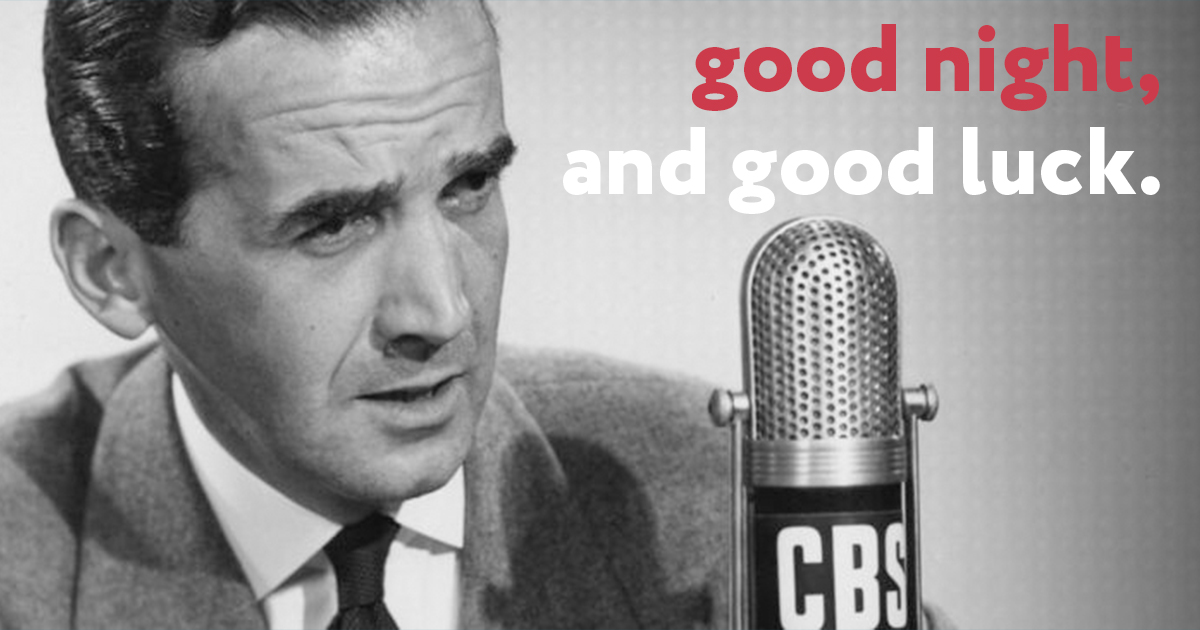
On June 7, CNN made history of sorts: The cable news network aired – live, in real time – a performance of Good Night, and Good Luck from New York’s Winter Garden Theatre. The broadcast marked the first time a Broadway production had been aired live on national TV. Co-written by George Clooney and based on his 2005 film of the same name, Good Night, and Good Luck dramatizes legendary journalist Edward R. Murrow’s televised stand against Sen. Joseph McCarthy in 1954, at the height of the Red Scare.
It was a landmark moment for theater, and a telling one for our modern media landscape. Here was a ’50s rendition of Murrow, portrayed by Clooney and warning against fear, demagoguery, and the corruption of truth. And here was CNN, a modern-day, multibillion-dollar media brand whose own content is often shaped by ratings incentives and partisan pressures, delivering that warning to millions. This irony was not lost on many.
Still, the lesson of Good Night, and Good Luck persisted: Journalism must serve the public interest. It must resist fear-based narratives. It must challenge power, not court it. These values, once considered the standard, are seen as quaint today as we all navigate a fragmented, over-monetized, deeply polarized media environment. It’s time those values are rediscovered, before it’s too late.
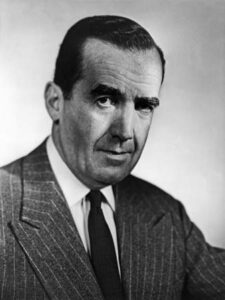 “To be persuasive, we must be believable; to be believable, we must be credible; to be credible, we must be truthful.” – Murrow
In Murrow’s day, mass media helped anchor the public in a shared understanding of events. From that shared understanding came political fights and policy showdowns, votes of conscience and votes of protest. You could welcome the news or denounce it, but you didn’t attack its veracity simply because you didn’t like it. Today’s media landscape, by comparison, practically encourages people to live in their own comfortable realities, each with its own facts, heroes, and villains – and reject all other realities as wrong.
This didn’t happen overnight, of course; we’ve been witnesses to it for decades. Over the past 30 years, the rise of the internet – and with it, the rapid democratization of publishing – shattered the domination that traditional media once held over public information. In many ways, that was a healthy development. It allowed for a broader range of voices and perspectives, particularly from communities that had been long excluded from legacy outlets.
But it also brought chaos. Once the gatekeepers fell, so too did many of the norms and standards that had helped the public distinguish fact from fiction. Social media platforms replaced editorial boards. Opinion blurred with reporting. Content farms mimicked headlines. Algorithms learned that outrage kept people glued to their screens and built entire empires off of our attention.
Now, as artificial intelligence fully enters the media ecosystem, the disruption is accelerating at almost unfathomable speed. Deepfakes are becoming indistinguishable from authentic footage. AI-generated articles flood the web with plausible-sounding, citation-free claims. Fabricated news can now be created and spread at lightning speed – faster than mortal fact-checkers can keep up.
The crisis we face is no longer just about media bias or partisanship. It’s about the very integrity of reality in the public square. That’s why it’s not enough to be literate; we must be news literate. We must teach and re-teach the skills of discernment: source evaluation, context analysis, digital skepticism. Importantly, we must also demand greater accountability from platforms, publishers, and public figures who knowingly distort or disseminate falsehoods for personal gain.
“The speed of communications is wondrous to behold. It is also true that speed can multiply the distribution of information that we know to be untrue.” – Murrow
Bad-faith actors don’t need a majority; they only need enough confusion, exhaustion, and mistrust to operate unchecked. They also don’t need to operate in darkness; they’re enabled by a media ecosystem that often rewards volume over veracity and conflict over clarity. In such a world, noise is mistaken for relevance, while falsehoods are given equal footing with facts in the name of “balance.”
This dynamic dulls our ability to discern what’s true, what matters, and what must be defended. And after a while, it’s tempting just to throw up our hands and declare everything we see as suspect. But we shouldn’t confuse skepticism with cynicism. Democracy requires more from us, especially now.
Most of all, it requires us to name what we’re witnessing. Voter suppression is not election integrity. Cruelty is not strength. Propaganda is not patriotism. All claims are not equally valid. And journalism is not performance art.
“I simply cannot accept that there are, on every story, two equal and logical sides to an argument.”– Murrow
Yet, mainstream corporate journalists continue to cling to outdated notions of objectivity that prioritize balance over truth. This is a not-small problem, since conventions of modern reporting were designed for a different era, one where troublemakers did not exploit those very norms to spread disinformation and sow doubt. Deliberate falsehoods are being deployed at scale, and simply reporting “what was said” is no longer enough. Journalists must be willing to draw lines, to fact-check in real time, and to name lies as lies. Most of all, they must treat the defense of democratic principles not as partisan, but as essential.
That doesn’t absolve regular Americans of responsibility. Public silence amounts to complicity. We know that the erosion of democratic norms often happens slowly, wrapped in familiarity, comfort, and the false promise that it won’t affect us.
This moment requires our vigilance: We have to be informed, not inflamed. We have to seek sources that prioritize truth over clicks. And we have to understand that if democracy is to survive, it won’t be because we were entertained, but because we were engaged.
“A nation of sheep will beget a government of wolves.” – Murrow
Remember: Those who came before us faced fear, corruption, and disinformation, too, and they met those challenges with courage. Factory workers organized unions during the Gilded Age. Civil rights leaders marched and risked jail. Journalists exposed Watergate and brought down a corrupt presidency. Each stood up in their own time so that we could stand in ours.
So, let’s follow their example. Let’s rebuild a shared commitment to truth. Let’s hold our media and ourselves to a higher standard. Let’s defend democracy not just with words, but with vigilance, courage, and moral clarity.
“We will not walk in fear, one of another. We will not be driven by fear into an age of unreason, if we dig deep in our own history and our doctrine and remember that we are not descended from fearful men. Not from men who feared to write, to speak, to associate, and to defend causes that were, for the moment, unpopular … There is no way for a citizen of the Republic to abdicate his responsibility.” – Murrow
This is for us to do – to prove, once again, that we are worthy of our inheritance.
