
Have you been to Civic Saturday yet? Since 2019, our quarterly gatherings have offered space to reflect, connect, and recommit to the shared work of democracy. As part of this ongoing practice, each gathering features a “civic sermon” – a deeper dive into the rights, responsibilities, and requirements of being a powerful citizen. Taken collectively, our sermons have built up a robust rhetorical catalog; that is, words and concepts that go beyond their literal meanings.
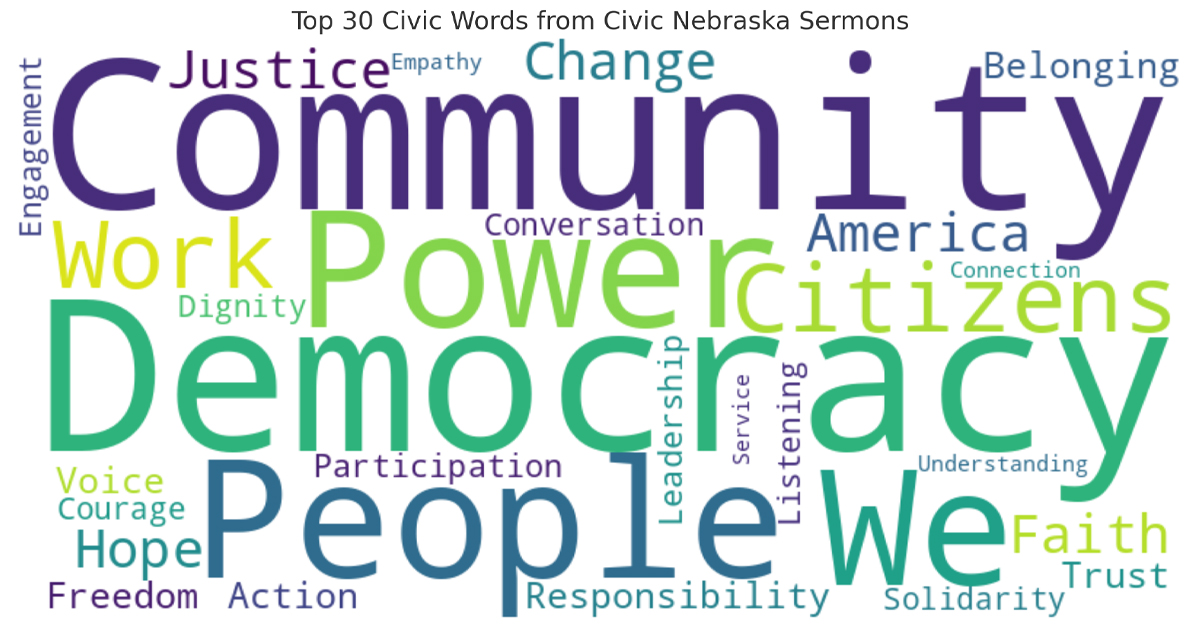
We wondered: What words do we invoke most often when wrestling with our nation’s founding creed and our roles and active modern citizens? So we analyzed the words most frequently used — the themes, values, and concepts that rise again and again. The AI-powered prompt generated the word cloud above, highlighting the 30 most-used words from our sermons.
Now, we invite you to look closer. For each word, we’ve included both its literal definition and our own civic interpretation — the lived, active meaning as it plays out in our democracy-building work. Words shape how we see the world, and when used with care and clarity, they can help shape that world for the better.
1. Action
The dictionary says: The process of doing something, typically to achieve an aim.
How we define action:
What makes our values visible. It’s the letter written, the meeting organized, the neighbor helped, the injustice named. A culture of democracy is built by people who act on what they believe.
2. America
The dictionary says: A country in North America comprising 50 states, formally known as the United States of America.
How we define America:
An evolving idea — unfinished, imperfect, and deeply contested. Its strength lies in our ability to reimagine it again and again, each generation contributing to the definition of liberty, justice, and belonging for all.
3. Belonging
The dictionary says: An affinity for a place or situation; the feeling of being accepted and included.
How we define belonging:
What holds communities together. It means knowing you are valued, that your presence matters, and that your contributions are needed. In a society that honors belonging, everyone has space to participate without fear of exclusion.
4. Change
The dictionary says: To make or become different; to replace something with something else.
How we define change:
It doesn’t always look dramatic. Often, it begins in quiet persistence: a conversation, a coalition, a campaign. Over time, those small efforts build momentum and open paths that weren’t visible before.
5. Citizens
The dictionary says: A legally recognized subject or national of a state or commonwealth, either native or naturalized.
How we define citizens:
The caretakers of the common good. More than a legal status, citizenship is the decision to take part, to claim responsibility, and to help create a society where all can thrive. It asks for more than presence; it calls for purpose.
6. Community
The dictionary says: A group of people living in the same place or having a particular characteristic in common.
How we define community:
The first classroom of citizenship. It’s the people you depend on, the spaces you gather in, and the culture you co-create. Democracy becomes real in community — where neighbors learn to solve problems, protect one another, and build trust that can’t be legislated from afar.
7. Connection
The dictionary says: A relationship in which a person, thing, or idea is linked or associated with something else.
How we define connection:
What gives democracy its human face. It’s built through shared work, shared space, and shared struggle. Without connection, civic life becomes hollow — with it, we create something that lasts.
8. Conversation
The dictionary says: A talk, especially an informal one, between two or more people, in which news and ideas are exchanged.
How we define conversation:
Where democracy breathes. It’s how we work through conflict, build consensus, and name our shared hopes. The ability to talk — and to be heard — is a civic skill worth protecting.
9. Courage
The dictionary says: The ability to do something that frightens one; bravery.
How we define courage:
A daily decision. It’s often quiet — saying the hard thing, staying in the room, taking responsibility. In civic life, it is the foundation of action when fear says to hold back.
10. Democracy
The dictionary says: A system of government by the whole population or all the eligible members of a state, typically through elected representatives.
How we define democracy:
A shared act of imagination and responsibility. It grows from the belief that we are capable of governing ourselves through fairness, inclusion, and care. It depends on participation, not just from time to time, but as a way of life.
11. Dignity
The dictionary says: The state or quality of being worthy of honor or respect.
How we define dignity:
The baseline for a just society. It’s the recognition that every person has worth, not because of their résumé or beliefs, but because they are human. When civic life honors dignity, it becomes something people want to be part of.
12. Empathy
The dictionary says: The ability to understand and share the feelings of another.
How we define empathy:
An invitation to slow down and consider what someone else might be carrying. It is the bridge between difference and care, and it fuels a more humane civic culture.
13. Engagement
The dictionary says: The act of being involved with something.
How we define engagement:
What democracy looks like between elections. It’s being in the room where decisions are made, asking good questions, and paying attention to what affects your neighbors. It keeps power close to the people.
14. Faith
The dictionary says: Complete trust or confidence in someone or something.
How we define faith:
Belief in our ability to solve problems together. It means staying engaged when it would be easier to withdraw, and trusting that people, even in disagreement, can still work for something good.
15. Freedom
The dictionary says: The power or right to act, speak, or think as one wants without hindrance or restraint.
How we define freedom:
Freedom gains its meaning when people have real access to it. That means equitable opportunity, safety, and dignity across race, gender, income, and geography. When systems reflect that, freedom becomes a shared reality.
16. Hope
The dictionary says: A feeling of expectation and desire for a certain thing to happen.
How we define hope:
A form of courage. It refuses to settle for what is, and instead invests in what might be. Hope is active, grounded in work and vision, and shared through action.
17. Justice
The dictionary says: Just behavior or treatment; the quality of being fair and reasonable.
How we define justice:
What fairness looks like when it shows up in the real world. It requires more than intentions — it requires design, courage, and follow-through. It is most visible when those who are usually ignored are finally heard, protected, and treated with care.
18. Leadership
The dictionary says: The action of leading a group of people or an organization.
How we define leadership:
An additive trait that can take many forms. It’s found in the person who speaks up in a meeting, the neighbor who starts a conversation, or the student who organizes a walkout. Real leadership is rooted in service and clarity.
19. Listening
The dictionary says: The act of giving one’s attention to sound; hearing attentively.
How we define listening:
What builds the foundation for trust. It allows us to understand where others are coming from, even when we disagree. It’s how we make room for learning and growth, both personally and collectively.
20. Participation
The dictionary says: The action of taking part in something.
How we define participation:
A habit of being involved, a willingness to contribute, and a decision to show up for your neighbors. It brings democracy out of theory and into the fabric of everyday life.
21. People
The dictionary says: Human beings in general or considered collectively.
How we define people:
Who holds the promise and the burden of democracy. Laws can shape a society, but people give it life. It’s in the hands, minds, and hearts of everyday individuals that our civic values are tested, refined, and renewed.
22. Power
The dictionary says: The ability or capacity to do something or act in a particular way; the capacity to influence others.
How we define power:
The ability to make things move, to shape outcomes, and to influence the future. It exists in every relationship, system, and institution, but also in every voice, every coalition, every act of care.
23. Responsibility
The dictionary says: The state or fact of having a duty to deal with something or of having control over someone.
How we define responsibility:
What gives democracy its shape. It’s the follow-through after the promise, the willingness to be accountable to others, and the commitment to care for a shared future.
24. Service
The dictionary says: The action of helping or doing work for someone.
How we define service:
How we put values into practice. Whether it’s mentoring youth, helping neighbors, or organizing for change, service makes abstract principles concrete. It reflects a commitment to the well-being of others.
25. Solidarity
The dictionary says: Unity or agreement of feeling or action, especially among individuals with a common interest.
How we define solidarity:
A form of civic kinship. It means standing beside others, especially those at risk, and acting as if their struggles are your own. It strengthens communities and makes real change possible.
26. Trust
The dictionary says: Firm belief in the reliability, truth, or strength of someone or something.
How we define trust:
The civic glue that holds institutions and relationships together. It is built when people show up, do what they say they’ll do, and remain accountable. When trust breaks down, the repair begins with listening and follow-through.
27. Understanding
The dictionary says: The ability to comprehend something; sympathetic awareness or tolerance.
How we define understanding:
What happens when we stay curious. It’s the result of listening well, asking better questions, and being willing to revise our assumptions. It doesn’t demand agreement, but it insists on respect.
28. Voice
The dictionary says: The sound produced in a person’s larynx and uttered through the mouth, as speech or song.
How we define voice:
How you can shape the direction of your community, your school, your workplace, your country. It’s not only what you say but how you say it, and when. It becomes powerful when it joins with others to call for what’s right.
29. We
The dictionary says: Used by a speaker to refer to himself or herself and one or more other people considered together.
How we define we:
A moral commitment. It reminds us that civic life is collective, that our fate is bound up with one another, and that when we act together, we can solve problems that feel impossible alone.
30. Work
The dictionary says: Activity involving mental or physical effort done in order to achieve a purpose or result.
How we define work:
In service of democracy, something that is never finished. It lives in the everyday tasks — making calls, attending meetings, offering care, asking hard questions. When done consistently, this kind of work becomes a civic muscle that can carry us through crisis and conflict alike.
