
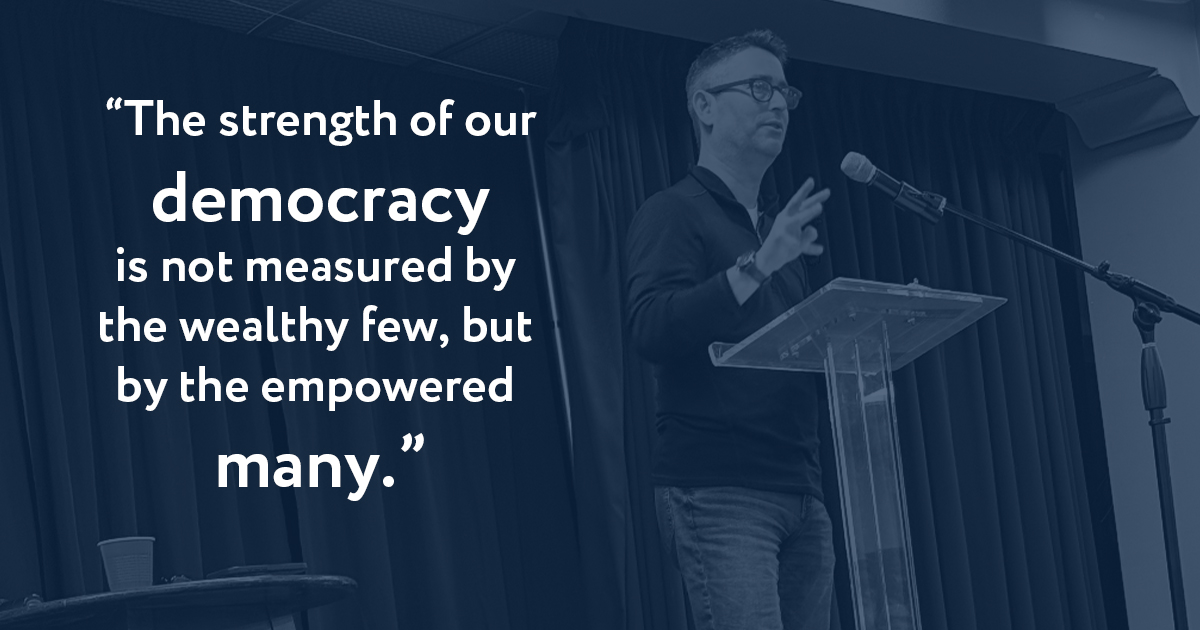
On April 26, 2025, Civic Nebraska convened Civic Saturday: POWER MOVES at First-Plymouth Church in Lincoln, where National Civic Saturday Fellow Steve Smith delivered the following “civic sermon.” Listen to the full gathering here, and learn more about Civic Saturdays here.

Those of you who know me know that my mother died in March. She was 82, and she had been living in memory care here in Lincoln due to her advanced Alzheimer’s. I’ll admit, the past year – her final in what was an uncharacteristically long Alzheimer’s journey – was tough. My family and I are still in that liminal space between grief and relief; of course, we miss her deeply, and in the month or so since Mom merged with the infinite, I find myself summoning memories and re-living moments that haven’t been dusted off in years.
She was my first and most enduring role model. She served as a U.S. Postmaster in four communities in Nebraska throughout her career; she was the president of our local school board; she was a church leader; and she was often recruited to head up community betterment committees, task forces, and any number of special projects.
Like all women of her era, she juggled her duties to family, career, and community — and always seemed to make it look easy.
 Most of all, my mother believed in the enduring promise of America, in both word and deed. As I wrote her obituary, I could feel a kind of civic pride rise in my chest. Now, I know some of you had the chance to meet her at a few of our gatherings over the years, and as we continue down this road without her, I feel her civic spirit with us today. (Points to empty chair with a star-spangled bow on it in the front row). It’s why we’ve held onto her seat for her.
During those final, difficult weeks, I was with Mom a lot – obviously. And for reasons that, in retrospect, are unclear, her television was on a lot in the background. I guess we just fired it up out of habit. And, it mostly was on AMC, which was showing a round-the-clock marathon of MAD MEN — all seven seasons, all 92 episodes, in order, one after the other, on repeat.
Is anybody else a fan of MAD MEN? Of smoking, drinking, and the 1960s? It’s hard to believe it’s been off the air for ten years. (Several hands go up) Yeah? OK, cool. We have a few fellow fans of the Sterling Cooper advertising agency here today. Nice.
In the quieter hours of those days, I thought to myself: This is kinda fitting. The era of MAD MEN was also my mother’s era. She graduated from high school in 1960, the same year the show’s timeline begins.
The show’s women were a lot like my mom. They faced condescension and exclusion as they entered the workforce. No matter their talent or ambition, women in 1960 were largely confined to limited, supporting roles in the lives of men. They were expected to just stay quiet, look pretty, and be grateful.
If they wanted power, they had to build it for themselves, often from scratch. So, many of them did. And my mom was part of this generation – she just didn’t have a lot of need for getting permission to pursue the person she wanted to be. So, she created her own power, brick by brick, and over the years, grew into a respected community leader.
So yeah, MAD MEN is also a study of power: Who holds it, who’s denied it, and how it’s used, abused, and sometimes even broadly transformed. Beneath the surface, it showed us a country on the edge of change. The men who ran Sterling Cooper advertising believed they controlled the world — shaping the narratives of what America was, what it wanted, and who got to matter. Moreover, they thought their power was permanent.
But then, what happened? The world began to shift. Women demanded more than secretarial work. African Americans entered rooms that were previously closed off to them. The counterculture challenged and eventually changed the establishment. MAD MEN showed us how personal transformation can mirror national transformation. It showed us how and why seemingly unchangeable systems bend, break, and evolve – when new voices refuse to be ignored.
MAD MEN was a really, really good story – because it was also the story of America.

If there’s one thing that you take away from my ramblings today, let it be this: Power is not a dirty word.
If anything, power is misunderstood – today, we largely see power as distant and elusive, a force possessed only by the wealthy, the connected, or the elected.
But this view is mistaken, my friends – and, if left unchallenged, this view is dangerous. Because when citizens believe they have no power, what happens?
That’s right; they leave it on the table for someone else to seize, and use, or even abuse.
But in America, power is not a simple result of personality, wealth, or luck. It’s a set of tools, and relationships, and actions. And most of all, it is something we all have the right — and the responsibility — to claim. To exercise.
So let’s talk about it. Today is a good day to speak the truth about power. Especially these three truths in particular:
Power is a fact.
Power is a gift.
And, power is a muscle.
Together, they point us toward an American future defined not by fear and helplessness, but of agency and action.
OK. The first truth is this: Power is a fact.
It’s as simple as that: Power is not good or bad in and of itself. It just … is. It’s like gravity or the weather – it simply exists, whether we choose to acknowledge it or not. And, just like other natural forces, power shapes everything around us, from the policies that govern our schools to the prices in our grocery stores to the voices that are amplified in our public debates.
But that framework isn’t complete, is it? Yes, of course, power can be top-down. But it’s also bottom-up, sideways, and distributed across networks. Power is wielded in palaces and boardrooms, sure; but it’s also exercised daily in neighborhoods, at public forums, and yeah, at the ballot box.
Power is a fact. That means to be empowered, we first have to recognize how it flows within our communities. Who sets the agenda in Lincoln, Omaha, and Nebraska? Who writes the rules? Who decides what gets funded, what gets ignored, and who gets heard? These are not philosophical questions — they are civic ones. Answering them requires that we view ourselves not as passive observers, but as active participants in our system. We must enter these spaces like we own them, because as citizens, we do.
This is especially critical in moments of crisis or change. There’s been plenty of both so far in 2025. When social norms break down, when institutions falter, or when trust erodes, again, power does not evaporate. It simply moves. The question then becomes: Who is prepared to guide it toward justice? Or fairness? Or common purpose?
If you’re here today, you already know the answer. The answer lies in everyday people who decide to step up, who decide to step forward. Who refuse to sit back and let others write their story for them. Because power is not bestowed; it’s claimed. It’s shaped through action – through organizing a neighborhood meeting, casting a ballot, attending a school board hearing, running for a local office, building a coalition, speaking out when it’s uncomfortable, or even just helping others understand their rights and responsibilities in our democratic society.
At its core, power is the ability to influence what happens next. And while this doesn’t always guarantee a just outcome, it does offer us an on-ramp. A starting point. Some fuel for change.
So let’s not be afraid of power. Let’s not treat it like a dirty word. Because when it’s wielded with character, with empathy, and with purpose, power becomes a tool for justice.
So the question isn’t whether power exists. The question is: Will we use it, and how?
The second truth is this: power is a gift.
And like any gift, it carries with it a choice: to hoard it, or to share it. To use it to dominate, or to circulate it and empower others.
You probably know which of those choices feels like it’s on offense right now. On so many fronts, we’re witnessing the heyday of the zero-sum worldview – power is seen as finite, power seen as something one person gains only if another loses.
But that view misunderstands the very nature of civic power. In healthy democracies, power is generative; the more it’s shared, the more it grows. When you help your neighbor navigate a public service, when you gather with like-minded folks to reflect or activate or organize, when a just movement punches through the noise and lifts up marginalized voices, power isn’t being lost, it’s being multiplied.
It’s being multiplied right here, and right now.
When people feel seen, heard, and valued – simply put, they are more likely to participate. And that participation deepens connection. And that connection strengthens the bonds that hold communities together. And those bonds create the kind of trust that allows for disagreement without disintegration.
Power as a gift means believing, truly, in abundance. It means understanding that dignity is not transactional. That leadership is not about control but about service. And that the most enduring movements are not those built on fear or grievance or retribution, but ones rooted in mutual care, and justice, and collective purpose.
This ethic is especially important in a time when many of us feel isolated, alienated, or helpless. Right now, there are men in Washington who are working to expand executive power, disregard long-established norms and laws, and erode the very foundation of our democratic republic. Our corporate media have become echo chambers shielding voters from the truth, treating what we’ve seen since January as merely a difference in political opinion. There’s an authoritarian grip on the American narrative right now, which has meant any long-term national vision has been replaced with short-term spectacle – and, I should say, the hollowing out of our country’s moral core.
Given all this, it’s easy to retreat into apathy or cynicism. But as I’ve said so, so many times before, the antidote to what ails us is not withdrawal. It is deeper engagement. And that begins with one person offering another the gift of power – and the chance to shape something together.
It might begin with a conversation, a meeting, or a shared project. It might be as small as asking someone what they care about, or as large as helping them run for office. But every act of inclusion, every act of mentorship, every act of encouragement is an investment. It’s an investment in democratic – small d-democratic – power. When scaled across a community or a nation, those investments can be transformative.
Treating power as a gift isn’t naive. If anything, it’s strategic. The kind of power that sustains democracy isn’t brittle – it’s resilient. And adaptive. And generous. It tells us we all belong.
The third truth is this: power is a muscle.
That’s right. And like our real muscles, our power must be exercised regularly; otherwise, what sets in? Right – atrophy. Like any form of training, building civic power requires discipline, effort, and endurance.
In other words, we have to make participation a habit. You can participate anywhere – school board meetings, community clean-ups, union halls, HANDS OFF protests, public comment sessions, and yes, every two to four years, elections.
Power requires persistence. You have to keep showing up.
Look, civic life is often messy, slow, and unsatisfying. Progress can feel incremental. Victories are partial at best, and setbacks are common. But this is the cumulative nature of democratic power. Each petition signed, each conversation held, each coalition built adds strength to The Body – capital T, capital B.
This is why organizing matters, friends. Not just mobilizing, which is about rallying people around a cause. Organizing fosters relationships, develops leadership among individuals, and establishes fair and durable systems. Organizing teaches people how to use their power, how to navigate institutions, how to negotiate differences, and how to persist in the face of inevitable opposition from those entrenched forces that brought us to this point.
The more Americans exercise their power, the more confident they become. And that confidence breeds agency. It creates a kind of feedback loop of engagement, where people begin to see themselves not just as constituents or consumers, but as active co-creators of a shared civic life.
To treat power as a muscle is to recognize that democracy is not something we inherit; it is something we build. If that’s not obvious by now, I don’t know what to tell you. It is only through the steady, repeated acts of participation that we become fit for the responsibilities of freedom. Worthy of them.
So, Power is a fact. Power is a gift. Power is a muscle.
These truths ask us not just to understand the world as it is, but as it can be.
These truths are not always easy, but they are always, always, always worth it. Because in the end, the strength of our democracy is measured not by the power of the wealthy few, but by the empowered many.
My mother, over her 82 years, became one of those empowered many.
She was part of a generation of American women who, in the 1960s, broke down barriers for those who followed. The ripple effect that she and so many other everyday Americans started in the era of MAD MEN continues today – and it even echoes. Once again, we find ourselves in a moment of rapid social transformation. Technology is upending industries. The workplace is changing. Demographics are shifting.
And just like in MAD MEN, some of us are clinging to the past. We’re amid a sweeping federal effort to drag us back to 1960, back to the state-sanctioned discrimination of pre-Civil Rights America, pre-Women’s Liberation America.
And, because we have willingly handed them the keys to so much state power, yeah – sometimes it feels like they’re going to succeed.
Well, I’m here to tell you that they won’t.
Because here’s the reality: Their grip is not absolute. Their authority is not infinite. And their vision for this country is far from inevitable. Far from it.
Friends, when Americans of character claim their civic power, we become one of the most unstoppable forces on the planet. And just like the brave patriots in our past who refused to accept the limits and barriers placed in front of them, we all now find ourselves facing an urgent test of American resolve.
Yes, there will be misfires. Yes, there will be false starts, and defeats. That’s all to be expected. But I know in my heart of hearts that our power of progress and protecting the common good will rise again — not through violence, not through hate, but through the collective power of a good and moral people who choose to believe in something more, something better.
It starts with you. With your words. With your choices. With your courage.
And when this chapter closes — and it will close — let it be said that in our nation’s time of need, we, the American people, did not back down.
That we held the line. That we stood up. That we remembered who we are.
Let it be said that, in this pivotal moment, we claimed our power – our collective power – and rose up to defend our unique and precious democracy.
So, I’ll see you out there.
Thank you.